Crypto Outlook in 2026 and the Geopolitical Impact on Price

As we move through the first quarter of 2026, the digital asset landscape has decoupled from the predictable "four-year cycles" of the past. Today, the crypto market is no longer just a playground for retail speculators; it is a primary battleground for geopolitical influence and a hedge against a fragmenting global financial system.

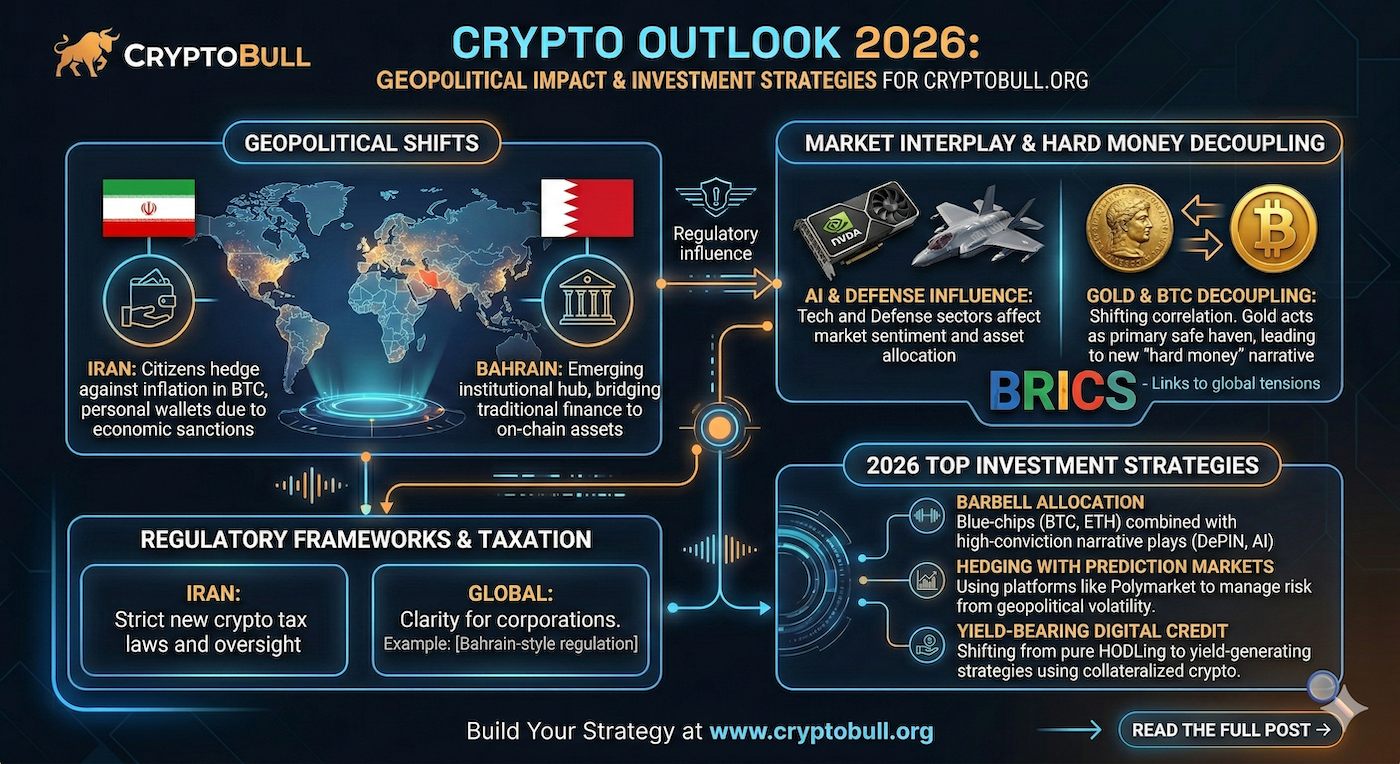
Infographic: 2026 Crypto Market Outlook and Geopolitical Strategy for CryptoBull.org

Are you still trading like it’s 2024? We just dropped the ultimate 2026 Crypto Outlook, including the top 3 investing strategies to survive the BRICS expansion and the AI/Defense stock correlation.

The Geopolitical Chessboard: Iran and Bahrain

The Middle East has emerged as the definitive "swing factor" for crypto liquidity this year.

  • Iran's Digital Sovereignty: In early 2026, Iran implemented a comprehensive crypto tax and regulatory framework. Faced with persistent inflation (climbing toward 50%) and a devaluing rial, Iranian citizens are increasingly moving capital into Bitcoin (BTC) and personal wallets to preserve wealth. This "flight to safety" has made Iran a critical node for organic, non-institutional demand.

  • Bahrain’s Institutional Hub: Conversely, Bahrain has solidified its position as a regulated entry point for institutional capital in the Gulf. By providing a bridge between traditional finance and on-chain assets, Bahrain is facilitating the "institutional era" that firms like Grayscale Research predicted would define 2026.

Market Trends: Gold, NVDA, and the Defense Sector

The correlation between crypto and tech remains high, but a new "hard money" narrative is forming. While NVIDIA (NVDA) continues to dominate AI infrastructure—impacting AI-focused tokens like Fetch.ai (FET)—investors are closely watching the defense sector.

Stocks like Lockheed Martin (LMT) are surging due to global tensions (e.g., renewed US-Iran friction and South American instability), often acting as a counter-signal to crypto’s "risk-on" appetite. Interestingly, gold has hit record highs above $5,000/oz, outperforming BTC in the short term as the ultimate safe haven.

Top 3 Investing Strategies for 2026

  1. The "Barbell" Approach: Allocate 50% to blue-chips (BTC/ETH) and 30% to Real World Assets (RWAs). Keep 20% in high-conviction "narrative" plays like DePIN or AI-agents.

  2. Prediction Market Hedging: Platforms like Polymarket have become essential tools. In 2026, smart traders use these markets to hedge against geopolitical events—such as the outcome of US-Iran diplomatic talks—before the volatility hits the spot markets.

  3. Yield-Bearing "Digital Credit": Move away from pure HODLing toward yield-generating vehicles. Many corporate treasuries are now pivoting to "digital credit" instruments that use BTC as collateral to fund operations, providing a more stable return in a high-volatility environment.


Stay ahead of the volatility: With the 2026 geopolitical landscape shifting by the hour, don't trade on yesterday's news—track real-time market sentiment and breaking alerts at the CryptoBull Insights Hub.

November's Volatility & December's Outlook: Crypto Bull Market Update

November shook out the weak hands, but smart money is prepping for new opportunities. We break down the month's volatility and identify the three biggest trends—from AI to RWA—that tactical traders should focus on heading into December 2025.

Read More

June 2025 Crypto Market Recap & July Outlook: Bullish Momentum and Shifting Tides

The cryptocurrency financial market experienced a dynamic and largely bullish June 2025, marked by significant institutional adoption, regulatory advancements, and continued innovation in the DeFi and AI sectors. As we move into July, the landscape appears ripe for further growth, though certain market signals suggest a need for strategic vigilance.

Key Updates and Happenings in June 2025

1. Institutional Inflows and Traditional Finance Convergence:

June saw an undeniable acceleration in the convergence of traditional finance (TradFi) and crypto.

  • Circle's Blockbuster IPO: The stablecoin issuer Circle's NYSE debut on June 5th, raising $1.1 billion and soaring 168% on day one, was a clear testament to institutional appetite for compliant crypto

  • Robinhood’s Hood’s Acquisition of Bitstamp: Just days prior, Robinhood's $200 million acquisition of Bitstamp on June 2nd, securing over 50 regulatory licenses, positioned the retail trading giant to expand its crypto offerings to both retail and institutional clients globally.

  • Stripe's Partnership with Privy: This collaboration further underscores the growing integration of crypto services into mainstream financial platforms.

  • Bitcoin and Ethereum ETF Developments: The market was abuzz with continued developments around Bitcoin and Ethereum ETFs. Trump Media & Technology Group's filing for a Truth Social Bitcoin & Ethereum ETF on June 24th fueled speculation about fresh institutional inflows, further legitimizing these assets in the eyes of traditional investors. Many analysts believe Bitcoin ETFs could introduce trillions in capital, solidifying Bitcoin's "digital gold" status.

2. Regulatory Clarity and Advancements:

June 2025 Crypto Market Recap & July Outlook: Bullish Momentum and Shifting Tides. While regulatory discussions are ongoing, June brought positive movement towards clearer frameworks.

  • US Senate Passes GENIUS Act: On June 16th, the bipartisan Guiding and Establishing National Innovation for US Stablecoins Act (GENIUS Act) passed the Senate, aiming to establish the first federal rules for regulating stablecoins. If passed in the House, this could provide much-needed clarity for a rapidly growing sector.

  • Dubai's Approval of Ripple's RLUSD Stablecoin: This regulatory greenlight from a major financial hub is accelerating stablecoin adoption on a global scale.

3. Market Performance and Sentiment:

Overall market sentiment in June leaned bullish, with the Fear & Greed Index climbing towards "Greed" territory.

  • Bitcoin's Resilience: Bitcoin demonstrated strong performance, breaching $110,000 at one point and holding above $107,000 despite some geopolitical shocks. Its market dominance remains significant, sitting around 60%.

  • DeFi Resurgence: The Decentralized Finance (DeFi) sector has been on a strong run over the past three months, with the total market capitalization of leading DeFi tokens (AAVE, UNI, MKR, BAL, SNX, CRV, COMP, SUSHI) increasing by 25.4% in 90 days. This resurgence is buoyed by improving regulatory clarity and continued innovation.

  • AI-Powered Crypto Apps: AI-driven decentralized applications saw explosive growth in June, with on-chain activity surging by 86% this year and significant funding inflows. AI agents are increasingly acting as on-chain copilots across DeFi, social platforms, and gaming.

4. Notable Events and Unlocks:

Several key events and token unlocks occurred, impacting specific asset prices.

  • EthCC[8] in Cannes (June 30th - July 3rd): This major Ethereum conference is a hub for developers and thought leaders, and its timing at the end of June and beginning of July could drive further innovation and interest in the Ethereum ecosystem.

  • Token Unlocks: Throughout the month, various projects like APT, ARB, ZRO, and OP saw significant token unlocks. While these can sometimes create selling pressure, the market generally absorbed them well, indicating strong underlying demand.

  • Bitcoin Solaris Presale: This new blockchain platform focused on scalability and utility saw its presale cross $5 million, with a projected 150% upside for early investors before its July launch.

Predictions and Coins to Watch for July 2025

As we step into July, the market appears poised for continued upward movement, but with a watchful eye on potential short-term volatility.

General Market Outlook:

  • Continued Bullish Momentum: The overarching sentiment remains positive, driven by institutional adoption and regulatory progress.

  • Potential for Altcoin Season: While June was largely a "Bitcoin Season" (Altcoin Season Index at 21), Bitcoin's consolidation around key resistance levels could create breathing room for altcoins to gain traction. Institutional diversification beyond BTC is also a factor.

  • Increased Volatility: Some internal market metrics suggest rising volatility for BTC, and the RSI approaching overbought thresholds indicates potential for short-term pullbacks.

Crypto Coins to Watch in July 2025

1. Bitcoin (BTC):

  • Prediction: Bitcoin is expected to maintain its dominance and potentially retest or break through the $110,000 resistance. Standard Chartered forecasts BTC could climb to $120,000 by mid-year.

  • Why to Watch: Its continued role as a market leader, increasing institutional interest via ETFs, and its perceived safety in a volatile environment make it a foundational asset. Keep an eye on the $101,000-$102,000 support level.

2. Ethereum (ETH):

  • Prediction: Ethereum is regaining traction and is poised for significant upside, with some analysts projecting ETH could reach $15,000 by the end of 2025. The anticipation around an Ethereum ETF and its robust DeFi and Layer-2 ecosystem are strong catalysts. Many anticipate a rise to $4,000 if the ETF is officially launched.

  • Why to Watch: The EthCC[8] conference will likely generate further interest and development within its ecosystem. Its continued innovation in staking yields and Layer-2 solutions positions it for substantial growth.

3. Solana (SOL):

  • Prediction: Solana is increasingly gaining attention from institutional investors due to its speed and scalability. Analysts predict potential gains from staking (6-8%) and anticipate an ETF could provide direct exposure.

  • Why to Watch: Its growing credibility and adoption in the financial sector make it a strong contender for a sharper rise than Bitcoin.

4. AI-Powered Crypto Projects:

  • Prediction: The explosive growth in AI-driven decentralized applications suggests this sector will continue its upward trajectory.

  • Why to Watch: As AI agents become more integrated into DeFi, social platforms, and gaming, tokens associated with strong AI-powered protocols and decentralized AI initiatives could see significant gains. Look for projects with tangible utility and active development.

5. Real-World Assets (RWAs) & DePIN:

  • Prediction: These narratives are gaining significant traction for the next crypto bull run.

  • Why to Watch: As blockchain technology continues to bridge the gap with the real world, projects focusing on tokenizing real-world assets and decentralized physical infrastructure networks (DePIN) offer unique value propositions and could attract substantial investment.

Important Considerations for July:

  • Macroeconomic Data: Keep an eye on inflation data (US Core PCE Price Index) and consumer sentiment reports, as these can influence overall market risk appetite.

  • Regulatory Developments: Any further clarity or major legislative movements (especially regarding stablecoins or ETFs) will be crucial.

  • Bitcoin Dominance: While altcoins are expected to gain, Bitcoin's ability to hold its ground will dictate the overall health of the market.

At CryptoBull.org, we believe June's developments have laid a strong foundation for the crypto market. While volatility is inherent, the increasing institutional adoption and regulatory momentum suggest a positive outlook for July and the remainder of 2025. As always, conduct thorough due diligence and consider your risk tolerance before making any investment decisions.


Major Milestone: Introducing the CryptoBull Insights Hub - Your New Edge in the Crypto Market!

Today, we're taking a monumental leap forward in providing you with the tools and data you need to truly thrive in the fast-moving crypto market. We are thrilled to announce the launch of our brand new partner site: CryptoBull Insights!

Located at https://insights.cryptobull.org/, the CryptoBull Insights Hub is designed from the ground up to be your go-to dashboard for live market data, cutting-edge trading tools, and real-time insights. This isn't just more content; this is live functionality built to give you a competitive advantage whether you're trading Bitcoin, Ethereum, Solana, or exploring other promising digital assets.

Read More

Understanding Cryptocurrency Market Cycles: A Beginner's Guide

New to crypto trading? Learn about cryptocurrency market cycles, including bull runs and bear markets, in this beginner-friendly guide. Understand market sentiment and trading cycles

Read More

Why Bitcoin Is Deflationary — And Why It Matters

🔄 Updated March 2026

Bitcoin's deflationary mechanics have taken on a new dimension in 2026. In addition to the supply dynamics covered below, the United States has now established a Strategic Bitcoin Reserve — a formal government policy treating BTC as a reserve asset alongside gold and foreign currencies. This is the first time a G7 nation has institutionalized Bitcoin at the sovereign level, fundamentally reinforcing the scarcity argument this post makes. Meanwhile, the April 2024 halving reduced the block reward to 3.125 BTC, cutting new supply issuance in half once again. With institutional treasuries, sovereign reserves, and retail investors all competing for a fixed supply of 21 million coins, the deflationary thesis has never had more real-world validation. The core mechanics below explain exactly why that matters.➡️ Track Bitcoin's live price, dominance, and market volume at the CryptoBull

Insights Hub → https://insights.cryptobull.org

In the world of cryptocurrencies, Bitcoin reigns supreme as the pioneer and the most well-known digital asset. One of the key attributes that sets Bitcoin apart from traditional fiat currencies is its deflationary nature. But what does this mean, and why is it significant?

To understand the concept of deflation, let's first clarify the difference between inflation and deflation. Inflation refers to the increase in the supply of money in an economy, which generally leads to a decrease in the purchasing power of that currency. In contrast, deflation occurs when the supply of money decreases or when the demand for a particular currency increases, resulting in an increase in the currency's value.

Now, let's delve into why Bitcoin is considered a deflationary asset:

1. Limited Supply: Bitcoin's most prominent deflationary feature is its capped supply. The Bitcoin network is designed to produce a maximum of 21 million coins. This scarcity is enforced by the halving events that occur approximately every four years, which reduce the rate at which new Bitcoins are created. As a result, Bitcoin becomes scarcer over time, and basic economics dictate that an asset in limited supply tends to increase in value.

2. Increasing Demand: As Bitcoin gains wider recognition and acceptance, its demand continues to grow. More investors, institutions, and even countries are considering Bitcoin as a store of value or a hedge against traditional financial systems. This increasing demand, combined with the fixed supply, reinforces the deflationary aspect of Bitcoin.

3. Long-term Perspective: Many Bitcoin holders view it as a long-term investment, rather than a medium of exchange for everyday transactions. This "HODL" mentality further reduces the circulating supply of Bitcoin and contributes to its deflationary tendencies.

4. Loss of Coins: Over the years, it's estimated that a significant number of Bitcoins have been lost due to forgotten keys, hardware failures, or other reasons. These lost coins reduce the effective supply, making each remaining Bitcoin more valuable.

While Bitcoin's deflationary nature has several advantages, such as protecting against the devaluation of fiat currencies, it also raises concerns. Critics argue that deflationary assets can discourage spending and economic growth, as people may hoard the asset instead of using it for transactions. However, proponents argue that Bitcoin's primary role is as a store of value, and other cryptocurrencies are better suited for daily transactions.

In conclusion, Bitcoin's deflationary attributes are rooted in its limited supply and increasing demand. As it continues to gain mainstream acceptance, its value is likely to appreciate over time, making it an attractive asset for those seeking a hedge against inflation and a store of value in the digital age. Nonetheless, the interplay of deflationary currencies like Bitcoin with traditional financial systems is a topic that will continue to evolve in the coming years.