Monad's Unlock Isn't 132% Of Supply. Here's The Real Math.

Monad's one-year anniversary unlock lands November 24, and the figures being quoted for it range from 6.66 billion MON to 10.7 billion — with some aggregators claiming it exceeds 132% of circulating supply. That last one is arithmetically impossible. Here is where it comes from.
Read More

AI agents made 138 million payments. The tokens made $69,094.

AI agents have made more than 138 million payments through the x402 protocol on Base, and the time from funding a wallet to its first payment has fallen from 73 days to 18 minutes. Over the same period the leading agent token's monthly protocol revenue fell from $14.49M to $69,094. Usage is compounding. Token economics are not. The agents settle in stablecoins.

Read More

io.net's October 11 Unlock: 3.45% of Float in a Single Day

io.net releases 14.14 million IO tokens on October 11 — 3.45% of circulating supply in one day, the largest percentage dilution in this week's unlock window. With 48.7% of total supply still locked and the token down 97.4% from its 2024 high, the question is whether a $2.38M release still moves a $69M market.
Read More

Solana Triples Transaction Size. Holders Should Do Nothing.

Solana's transaction v1 upgrade activates September 9, raising the maximum transaction size from 1,232 to 4,096 bytes. It unlocks on-chain ZK proofs and large multisigs for builders. For anyone simply holding SOL, no action is required — and the token has already gained 36% in thirty days heading into it.

Read More

XRP at $1 Into the Aug 19 White House Crypto Meeting

Ripple is a confirmed attendee at the August 19 White House crypto meeting, the only dated, asset-attributable regulatory event in the window. XRP trades at $0.9999, 72.6% below its July 2025 peak — and the bill that would actually reprice it carries roughly 17% odds on Polymarket.

Read More

Hot Coins for Summer 2026: 2 Picks Still Running + 3 New Names (SOL, ICP, SYRUP)

Crypto is bleeding. Bitcoin is roughly 51% off its peak, Ethereum is at two-year lows, and the Fear & Greed Index is buried deep in fear. (We broke down exactly what's driving the selloff — and why it looks more like a flush than a collapse — in our June 2026 selloff breakdown.)

This is precisely the environment our Hot Coins list is built for. We don't measure picks by how they feel in a green week — we measure them from the bottom to the all-time high. That frame is why LINK ran +4,796%, NANO +4,603%, and HNT +3,990% across prior cycles. The biggest moves are built when sentiment is at its worst.

So here's where our active picks stand, and three new names we're adding for the summer.

Still Running: Our Active Picks

KITE — The AI Agent Layer-1

Current price: ~$0.20 | Called at $0.07 on November 6th — a 153% move.

Kite is the native token of an AI-focused Layer-1 built for the "agentic economy" — a network where autonomous AI agents transact, pay for services, and settle on-chain without a human in the loop. The thesis when we called it hasn't changed: as the AI-agent narrative matures, infrastructure that lets agents actually pay each other becomes critical plumbing. KITE's tokenomics tie demand directly to network usage, with transaction commissions creating structural buy pressure.

It's pulled back from its March high alongside the broader AI-token cooldown, but it remains well above its launch levels. Verdict: still a hold. This is a high-beta bet on a narrative, not a blue chip — size accordingly.

HYPE — The Standout That Defied the Crash

Current price: ~$58.60 | Called at $8.00 on September 14th — a +653% move.

Hyperliquid is the rare name that went up during this selloff. HYPE set a new all-time high near $75.51 in early June — briefly overtaking Solana in market cap — while the rest of the market was getting liquidated. The reason is structural: 97% of the protocol's trading fees feed an Assistance Fund that continuously buys back and burns HYPE, so as the platform's perp-trading volume grows, the token absorbs constant bid. A spot HYPE ETF (Bitwise) launched in May added an institutional access point on top of that.

This is the cleanest example of our core thesis — a token whose value is tied to real, measurable platform activity rather than pure speculation.

One near-term risk to watch: a large token unlock (~$684M / ~9.92M HYPE) is scheduled for June 6, which can introduce short-term selling pressure. Verdict: still a hold, but expect volatility around the unlock.

3 New Hot Coins for Summer 2026

The common thread across these three: the price chart looks broken, but the underlying fundamentals are pointing the other way. That gap is the entire opportunity.

Cryptobull has you covered for top crypto coins heading into Summer 2026!

1. Solana (SOL) — The Divergence Play

Current price: ~$69

On price alone, SOL looks wrecked — its lowest level since December 2023, after the longest monthly losing streak in its history. But the institutional money is doing the opposite of what the chart suggests: while Bitcoin and Ethereum ETFs hemorrhaged billions, Solana's spot ETFs posted their best month of 2026 (roughly $15.6M in net inflows in a single recent week), with total Solana ETF assets crossing $1 billion. Underneath that, the network is still processing tens of millions of daily transactions with billions in DeFi value locked, and pending upgrades plus a tokenomics proposal aimed at curbing dilution sit on the horizon.

Why it's a Hot Coin: capital is rotating into SOL during peak fear. That's a tell. Risk: as a high-beta asset, SOL amplifies every market-wide move — it will fall harder if BTC breaks lower. Watch the $65–$67 support shelf.

2. Internet Computer (ICP) — The Deep-Value AI/Compute Bet

Current price: ~$2.80

ICP is the most ignored top-tier infrastructure project in crypto. It trades roughly 99% below its all-time high — yet it leads every major blockchain in monthly transaction volume, has shipped an AI development platform with real user growth, and locked in cloud infrastructure integration that no other Layer-1 has matched. The pitch is simple: it's the most complete attempt at running entire applications permanently on-chain, with no centralized component. A "Mission 70" tokenomics proposal aims to cut inflation by 70% by end-2026, which would meaningfully tighten supply if real usage keeps burning cycles.

Why it's a Hot Coin: the price reflects five years of market apathy; the tech and usage metrics tell a completely different story. This is a deep-value, multi-year asymmetry bet that also rides the AI/decentralized-compute narrative. Risk: the market has ignored ICP for years — it may keep ignoring it. This is a conviction hold, not a quick flip.

3. Maple Finance (SYRUP) — Real Yield, Real Revenue

Current price: ~$0.16

We've covered Maple before, and the selloff has only sharpened the setup. SYRUP is down roughly 76% from its 2025 peak, but Maple is one of the few DeFi protocols generating real, growing protocol revenue from institutional on-chain lending, with assets under management reaching multi-billion-dollar scale. This is the "RWA / institutional DeFi" thesis with actual cash flows behind it — not a narrative waiting for a catalyst.

Why it's a Hot Coin: a revenue-generating protocol trading at a sub-$200M market cap during a fear-driven flush is the kind of fundamentals-vs-price gap our list is designed to catch. Risk: small-cap DeFi is illiquid and volatile; it bleeds fast in risk-off tape and rebounds just as sharply. Position size is everything here.

The Summer 2026 Hot Coins at a Glance

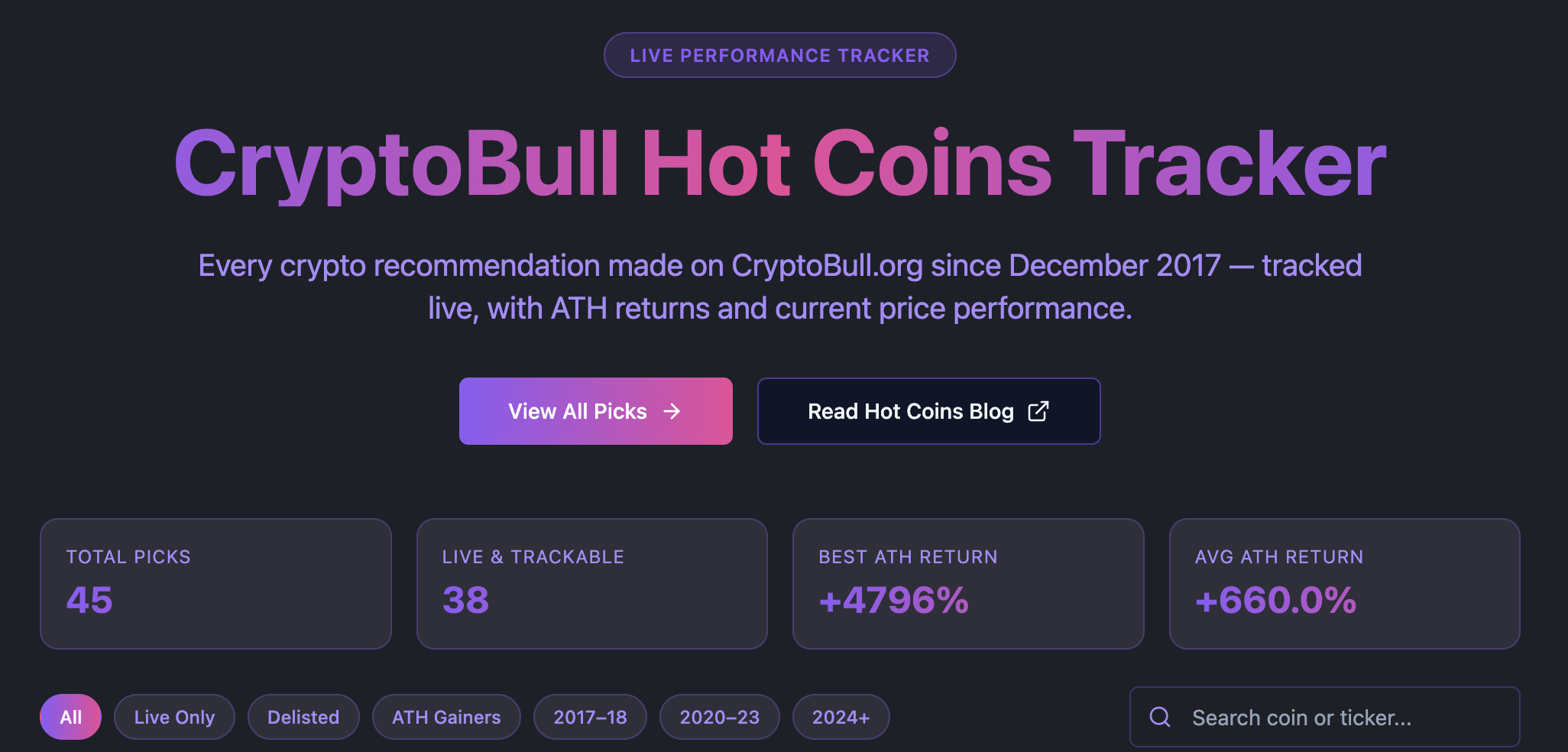
(See the comparison table below.) Prices are as of publication and will move — the live, real-time performance record for every pick lives on our Hot Coins Tracker.

Coin Status Price (Early June '26) The Thesis Key Risk
KITE Active hold ~$0.20 AI-agent Layer-1; usage-tied demand. High-beta AI narrative; off its ATH.
HYPE Active hold ~$58.60 Fee buyback/burn; made new ATH in the crash. ~$684M token unlock June 6.
SOL New pick ~$69 ETF inflows diverging from falling price. High-beta; amplifies market drops.
ICP New pick ~$2.80 Deep value; leads chains in tx volume; AI/compute + deflation proposal. Market has ignored it for years.
SYRUP New pick ~$0.16 Real protocol revenue; institutional DeFi/RWA. Small-cap, illiquid, volatile.

How to Approach This List

Fear is the entry point, not the exit. But that doesn't mean reckless. The same rules apply to every name above:

  • Dollar-cost average. Nobody nails the bottom.

  • Stick to your conviction tier. HYPE and SOL are higher-liquidity; ICP and SYRUP are deeper-value, higher-volatility bets.

  • Size for survival. This market can go lower before it goes higher. Only deploy what you can leave alone.

The bottom may not be in. These are names we believe are positioned to outperform through a recovery — not a guarantee the pain is over.

This article is for informational and educational purposes only and does not constitute financial, investment, or trading advice. Cryptocurrency is highly volatile and you can lose your entire investment. Nothing here is a recommendation to buy or sell any asset. "Hot Coin" designations reflect our editorial view, not a prediction of returns. Prices cited are as of early June 2026 and will change. Always do your own research and consult a licensed financial professional before investing.

Hot Coin Alert: Why $OSMO at $0.067 Is a Coiled Spring on Cosmos Merger 2.0

At CryptoBull.org, we love when a real catalyst gets temporarily over-priced by traders and then sold back to where it started. That's exactly the setup $OSMO is offering right now.

In the last 48 hours, Osmosis has done something wild: it pumped 185% on revived Cosmos Hub merger speculation, hitting an intraday high of $0.1072, before retracing -36.8% back to $0.06748 as front-runners took profits.

The merger catalyst didn't disappear. The traders chasing it did.

This is the kind of post-pump dip where the underlying thesis hasn't changed but the price has cooled enough to offer a credible entry. Osmosis remains the dominant DEX in the Cosmos ecosystem, with $40B+ in lifetime trading volume, connectivity to 140+ blockchains via IBC, and one of the most asymmetric merger catalysts in DeFi sitting unresolved on the table.

Here's the breakdown.

The Thesis: A Real DEX Token With an Unresolved Catalyst

Osmosis isn't a new project chasing a narrative. It's been operational since 2021 as the primary liquidity venue for the Cosmos ecosystem — an appchain-native DEX that has facilitated over $40 billion in lifetime trading volume and connects more than 140 sovereign blockchains through IBC (Inter-Blockchain Communication).

The token got punished alongside the rest of DeFi through 2024–2025, falling 99%+ from its 2022 ATH of $11.21 to a March 2026 low of $0.029.

Then came the merger debate.

🔥 The Catalyst: The COSMOSIS Merger Saga (And Why It's Not Over)

Here's the timeline that matters:

  • March 11, 2026 — The COSMOSIS proposal is posted: convert all circulating OSMO to ATOM at a fixed rate of 1.998 OSMO → 0.0355 ATOM over a six-month window.

  • April 2026 — Cosmos Hub governance narrowly rejects the proposal. Osmosis announces it will continue as "an independent, profitable blockchain."

  • May 11, 2026 — OSMO surges 185% in 24 hours as community members publicly float a revised proposal — potentially a hostile-takeover path where Hub governance drafts a new offer directly to OSMO holders.

  • May 12, 2026 (today) — Profit-takers exit. OSMO retraces -36.8% to $0.06748. Catalyst remains alive.

The key takeaway: the merger isn't dead — it's pending revival. The 185% pump confirmed that the market assigns meaningful probability to eventual integration. The 36% dump is traders cycling out, not the thesis breaking.

💎 Why the DEX Itself Is the Floor

Even if the merger never happens, OSMO has real, defensible product-market fit that justifies the floor at current levels:

  • Multi-Chain DEX Hub: Primary liquidity venue for Cosmos; bridges to Ethereum, Solana, Avalanche, Polkadot, and Bitcoin.

  • 140+ IBC Connections: A cross-chain network effect that is nearly impossible to replicate.

  • Concentrated Liquidity: Capital-efficient pools comparable to Uniswap V3, but native to the appchain.

  • Smart Accounts + 1-Click Trading: UX features only possible because Osmosis owns the full chain stack.

  • Superfluid Staking: Stake AND provide liquidity simultaneously — yield on the same capital twice.

  • Profitable Operation: $5.5M in 2025 revenue against $550K in operating costs. Genuinely profitable DeFi infrastructure.

This is not a vapor token. This is a profitable DEX with real volume, real fees, and real users.

Crypto Bull analysis graphic for $OSMO at $0.067 following a post-Cosmos merger pump, highlighting a 'coiled spring' entry point.

$OSMO Coiled Spring Trade: The Post-Pump Dip Analysis

$OSMO Token: Real Utility, Not Governance Fluff

OSMO powers the network across four functions:

  • Gas & Transaction Fees: Every swap, stake, or vote pays in OSMO.

  • Staking & Security: Validators secure the proof-of-stake chain by staking OSMO.

  • Governance: Holders vote on protocol direction — including the next chapter of the merger debate.

  • Liquidity Incentives: Emissions reward LPs across the DEX's pools.

Supply: Circulating supply is ~773M of a 980M total (1B max). Most of the float is already unlocked, reducing the unlock-driven sell pressure that plagues newer tokens.

The Upside Case at $0.067

  • Price — $0.06748 (-36.8% in 24h): Still 99% below ATH of $11.21. Cooled off after a 185% pump — clean re-entry zone.

  • Market Cap — $52.4M: Tiny vs. peer DEX tokens. Uniswap, Curve, and PancakeSwap trade at 5–20x this valuation.

  • TVL — $18.7M: Real capital actively deployed in pools — not a synthetic number.

  • 24h Trading Volume — $88.5M: Volume ratio (~1.7x market cap) signals genuine market activity, not dead liquidity.

  • Lifetime DEX Volume — $40B+: Real product, real revenue history.

  • 24h Range — $0.06547 → $0.1072: The range itself is the opportunity. You're buying at the bottom of yesterday's range.

If a revised merger proposal passes: the 1.998 OSMO → 0.0355 ATOM conversion math implies a re-rate based on ATOM's price. At current ATOM levels, that's a meaningful premium to today's spot.

If the merger doesn't happen: you still own equity in the dominant multi-chain DEX in Cosmos at a $52M market cap — generating real revenue, with 140+ chains plugged in.

⚠️ The Risks — Read This Before You Buy

We don't sell hopium. Real risks at $0.067:

  1. Second merger attempt could also fail. Cosmos Hub governance already rejected this once. A revised proposal isn't guaranteed to clear.

  2. The 36% dump may not be done. If volume keeps fading and broader alts sell off, OSMO could revisit the $0.05 zone or even retest the March ATL of $0.029.

  3. Overhead resistance. Technical resistance sits in the $0.085 pivot and the broader $0.22–$0.30 zone. The current move has work to do before breaking structure.

  4. Cosmos ecosystem dependency. OSMO is tied to Cosmos's developer mindshare. If capital keeps rotating to Solana or Ethereum L2s, OSMO suffers downstream.

  5. Speculative bid is fragile. The 185% pump was front-running, not accumulation. Expect choppy price action until governance signals a real revised proposal.

The Bottom Line

$OSMO at $0.067 is a coiled-spring trade. You're buying after the speculative top blew off, but before the catalyst resolves. The downside is bounded by the underlying DEX business (real revenue, real users, real volume). The upside is asymmetric if merger 2.0 gets formally drafted.

This is a watchlist-and-scale-in setup, not a "back up the truck" buy. Position size accordingly. Watch governance signals from both Osmosis and Cosmos Hub. And do your own research.


Want More? Track our past hot coin calls and their performance on the Hot Coins Tracker.

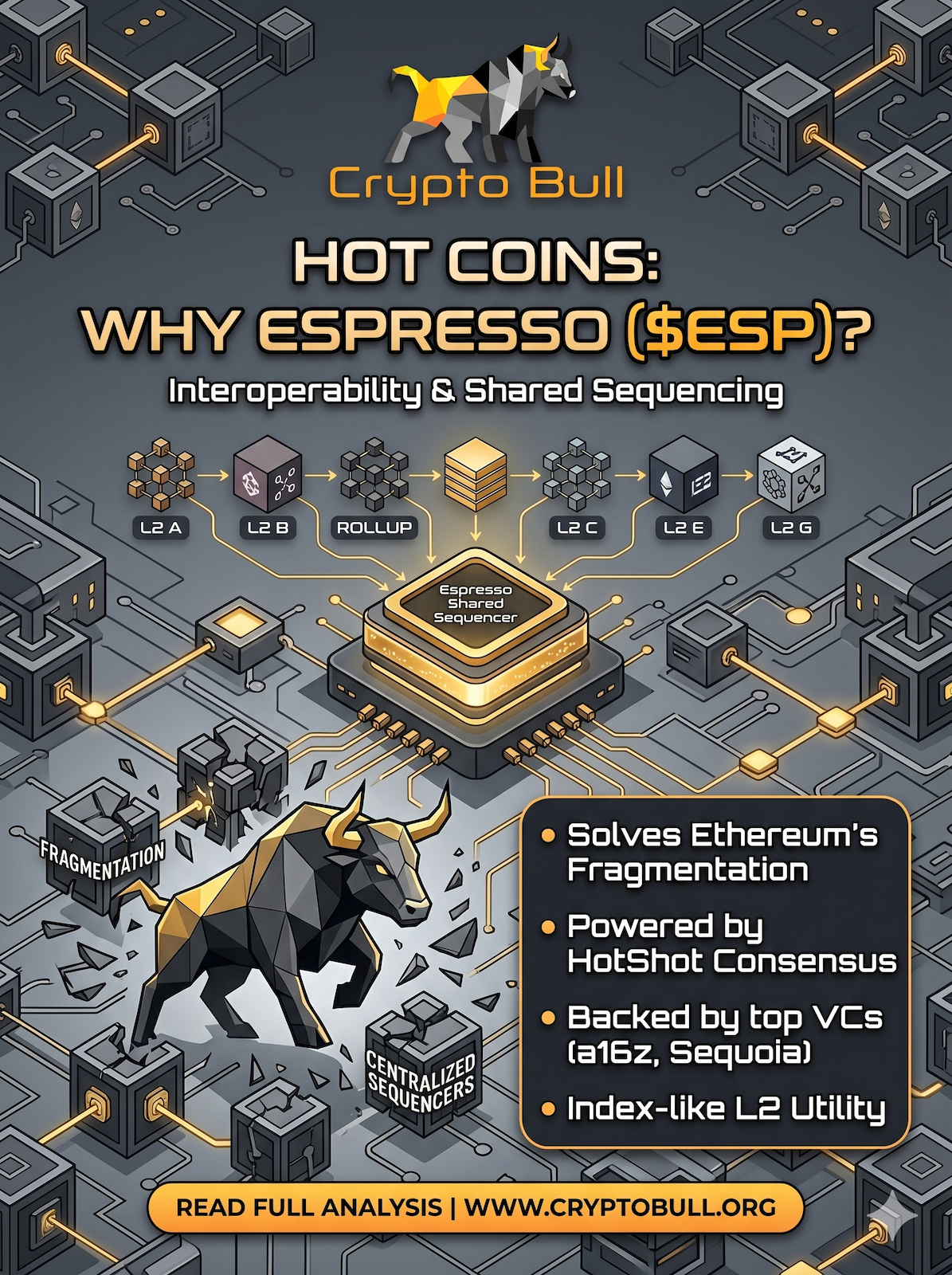
Hot Coin Alert: Why Espresso ($ESP) is the Missing Link for Ethereum’s Layer 2s

Is Espresso ($ESP) the Solution to Ethereum’s Fragmentation Problem?

The Ethereum ecosystem is more powerful than ever, but it has a glaring issue: fragmentation. With dozens of Layer 2 (L2) networks like Arbitrum, Optimism, and Polygon operating as "walled gardens," moving assets and data between them is often slow, expensive, and risky.

Enter Espresso ($ESP)—the "Hot Coin" we’re watching this week. Espresso isn’t just another L2; it’s the decentralized "connective tissue" designed to unify the entire modular ecosystem.

Espresso Crypto ESP Token Logo and Ethereum Scaling Diagram

What is Espresso ($ESP)?

At its core, Espresso is a Shared Sequencing Layer.

In the current landscape, each L2 uses its own "sequencer" to order transactions. Most of these are centralized, creating a single point of failure. Espresso replaces these with a decentralized network that can handle sequencing for multiple rollups simultaneously.

Key Technical Highlights:

  • HotShot Consensus: A high-speed Proof-of-Stake protocol that allows for "fast finality"—confirming transactions in seconds rather than waiting for the Ethereum mainnet.

  • Atomic Interoperability: Because Espresso sequences multiple chains at once, it enables "atomic" cross-chain actions. Imagine swapping a token on Chain A and receiving it on Chain B in a single, seamless transaction.

  • Backed by Giants: The project is supported by heavy hitters like a16z crypto, Sequoia, and Electric Capital, signaling deep institutional confidence.

The $ESP Tokenomics & Utility

The $ESP token is the fuel of the network. It serves three critical roles:

  1. Staking: Validators must stake ESP to participate in the sequencing marketplace.

  2. Protocol Fees: Rollups pay fees in ESP to access decentralized sequencing and data availability.

  3. Governance: Token holders vote on network upgrades and the integration of new partner chains.

Why $ESP is Trending Right Now

As of 2026, $ESP has seen a surge in volume following major exchange integrations. While the market cap is still evolving, its role as a "utility provider" for all L2s gives it a unique value proposition—if the Layer 2 ecosystem grows, Espresso's necessity grows with it.

The CryptoBull Verdict

  • Bull Case: If Espresso becomes the industry standard for shared sequencing, it could capture a massive portion of the transaction fees currently fragmented across the L2 landscape.

  • Bear Case: Competition in the "interoperability" and "sequencing" space is fierce. Success depends on the adoption rate by major rollup providers like Base or ZK-Sync.

Cryptobull Insights Hot Coins Tracker tracks all our picks in real time - check it out! https://insights.cryptobull.org/hot-coins-tracker

Sources & Project Links

Disclaimer: This is not financial advice. Crypto markets are volatile. Always do your own research (DYOR) before investing.

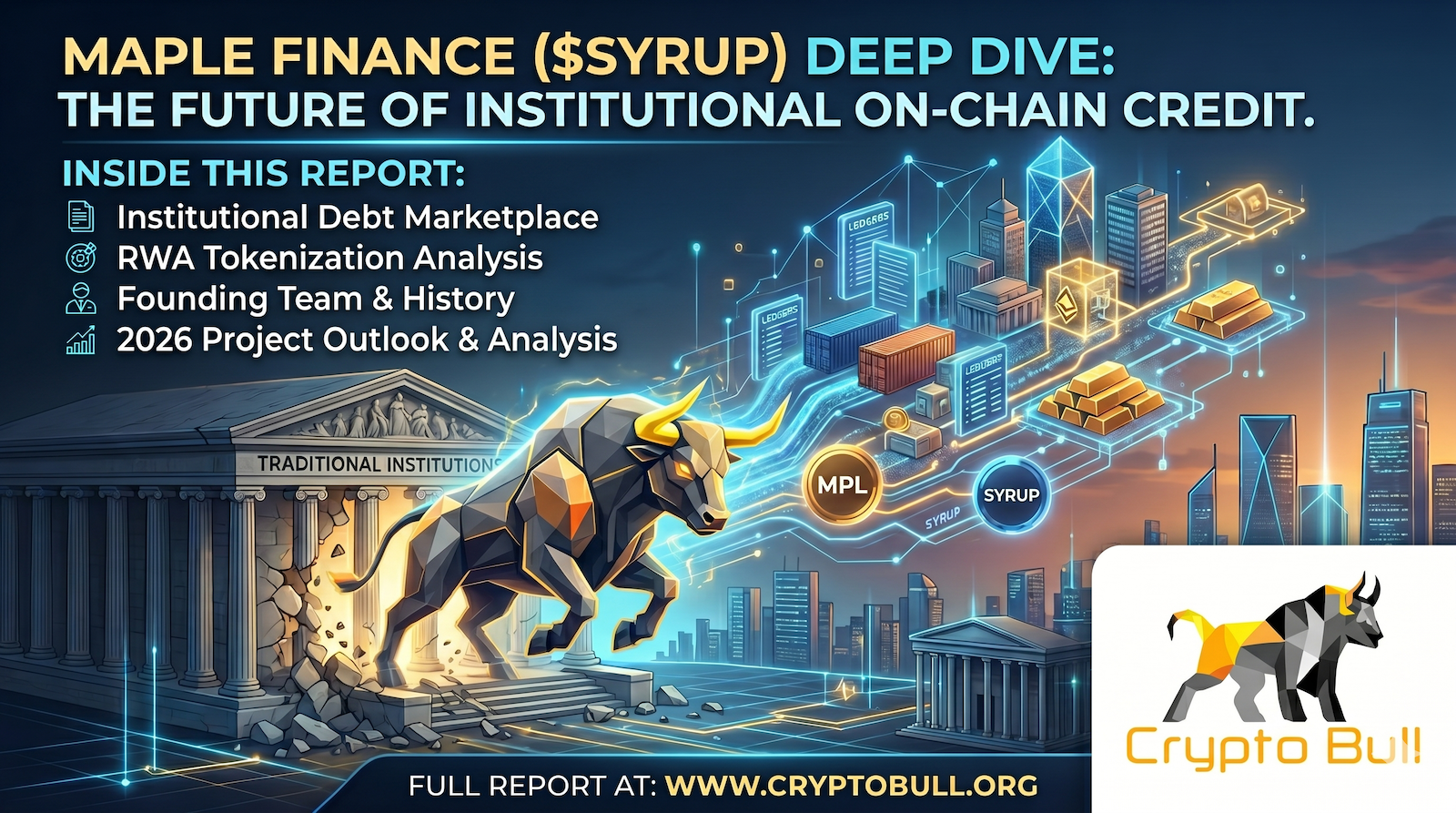
Maple Finance (SYRUP) Deep Dive: Institutional On-Chain Credit and the RWA Lending Opportunity in 2026

What Is Maple Finance?

Maple Finance is an institutional-grade, decentralized corporate debt marketplace built on Ethereum and Solana. It sits at the intersection of traditional finance (TradFi) and DeFi — enabling institutional borrowers to secure tailored financing (both undercollateralized and overcollateralized) while giving lenders access to sustainable, premium yield backed by real credit underwriting.

This is not a retail yield farm. Maple is building on-chain capital markets infrastructure.

The Team

Maple was founded in 2019 and launched in 2021. Leadership is anchored by traditional finance operators with verifiable track records:

  • Sidney Powell (Co-Founder & CEO) — Prior to Maple, participated in over $3B in corporate bond issuance and managed a $200M+ bond funding program at a commercial lending FinTech.

  • Joe Flanagan (Co-Founder & Executive Chairman) — Deep background in financial operations and strategy.

  • Matt Collum (CTO) and Ryan O'Shea (COO) round out the core team.

The broader team includes alumni from J.P. Morgan, Bank of America, Deutsche Bank, BlackRock, and PIMCO. This is not an anonymous dev team — it's a protocol built by credit professionals for institutional adoption.

Cryptobull makes a strong case for Maple Finance’s $SYRUP token

How Maple Got Here: The 2022 Stress Test

Maple launched into the 2021 bull market as a leader in uncollateralized institutional lending. The 2022 crypto collapse exposed its early weakness: bad debt from over-leveraged trading firms caught in the deleveraging spiral.

Rather than folding, Maple rebuilt. The team overhauled risk management, tightened underwriting standards, and pivoted aggressively into Real-World Assets (RWAs) and secured institutional lending. That pivot is what defines Maple today.

Current State (Early 2026)

Maple has emerged as one of the dominant protocols in the RWA and on-chain credit sector. Key developments:

  • Dual-token ecosystem: Legacy MPL (governance) and SYRUP (yield-bearing, protocol growth-linked)

  • Yield products: syrupUSDC and syrupUSDT — transparent, overcollateralized lending returns

  • Tier-1 integrations: Aave V3 (SYRUP listing targeted), Coinbase, Binance

  • Permissioned secured lending pools for sophisticated allocators

Market Opportunity

The macro narrative is clear: institutional capital is moving on-chain, and RWA tokenization is the bridge.

Maple's structural edge is capital efficiency. Traditional DeFi requires overcollateralization — borrowers lock up more than they borrow. Maple's model allows institutions to borrow against off-chain reputation, verifiable financial health, or specific secured collateral. That unlocks real credit flow into the digital economy in a way overcollateralized protocols simply cannot replicate.

The addressable market for tokenized assets is projected in the trillions. Maple is positioned at the intake valve.

$SYRUP Token Data Snapshot (April 2026)

Metric SYRUP
Price ~$0.248
24H Volume ~$17.75M
Market Cap ~$288.9M
CMC Rank #117
Circulating Supply ~1.16B of 1.21B total

Supply note: With ~96% of tokens already in circulation, the risk of future unlock-driven sell pressure is significantly reduced compared to early-stage token structures.

The Bull Case

  • RWA lending is one of the highest-conviction macro theses in crypto right now

  • Maple has survived a real stress test and emerged with stronger risk infrastructure

  • SYRUP tokenomics tie holders to protocol fee growth — not just governance optics

  • Regulatory clarity on stablecoins and tokenized securities directly benefits compliant, institutionally-focused protocols like Maple

Bottom line: Maple Finance is infrastructure, not speculation. For investors building a high-conviction RWA position, it warrants serious due diligence.

Sources

CryptoBull.org publishes independent research and market analysis. Nothing here is financial advice. Always conduct your own research before making investment decisions.

Hot Coins March 2026: 5 Altcoins With Confirmed Catalysts During Extreme Fear

The Fear & Greed Index hit single digits this month. But panic markets are where catalysts matter most. Here are 5 altcoins with confirmed near-term catalysts and the fundamentals to back them up.

Read More

🔥 Hot Coins 2026: The 5 Crypto Projects That Could Rocket the Rest of the Year

CryptoBull's updated Hot Coins list for 2026 breaks down the top 5 crypto projects to watch — Bitcoin, Ethereum, Solana, KITE, and CRO — with current prices, key catalysts, and why the second half of 2026 could send them flying. Updated monthly.

Read More