
The June 2026 Crypto Selloff: What's Driving It — and 3 Coins Worth Watching on the Dip (BTC, ETH, SOL)
The first week of June 2026 has been brutal for crypto. Bitcoin is trading in the low-$60,000s — roughly 51% below its October 2025 high near $126,200. Ethereum is sitting at its lowest sustained level in over two years. Solana just printed its lowest price since December 2023. Across the board, the Fear & Greed Index is buried in fear, and over $1.7 billion in leveraged positions were wiped out in a single 24-hour stretch this week.
If you're staring at red candles wondering whether the bull market is over, you're asking the wrong question. The better question — the one that's built real wealth in every prior cycle — is whether this is a structural collapse or a sentiment-driven flush. Based on what's actually driving the move, this looks far more like the latter.
Here's the breakdown.
What's Actually Driving the Selloff
This isn't one thing breaking. It's a stack of pressures hitting at once, most of them macro and short-term rather than crypto-native and structural.
Record ETF outflows. U.S. spot Bitcoin ETFs logged their largest-ever weekly outflow — roughly $3.4 billion — the biggest single-week withdrawal since they launched in 2024. Ethereum ETFs have now strung together their longest net-outflow streak on record. When institutions redeem at this pace, it pulls direct bid out of the market.
Macro is risk-off. Sticky inflation, a stronger dollar, and a Fed that's signaling "higher for longer" — with some officials refusing to rule out hikes — have pushed capital toward cash, bonds, and gold. Add ongoing geopolitical tension out of the Middle East, and risk assets across the board are getting sold.
Leverage got flushed. A lot of this move is mechanical. Over-leveraged longs got liquidated in a cascade, with bullish traders accounting for the overwhelming majority of forced selling. That's painful in the moment, but it's also how markets reset froth and build a healthier base.
Cycle psychology. We're deep in the four-year cycle window where sentiment historically turns sour and weak hands capitulate. None of this is new. It rhymes with every prior shakeout.
Notice what's not on this list: no major protocol failure, no exchange blowup, no fundamental break in the underlying networks. The chains are processing transactions, DeFi is functioning, and developer activity hasn't fallen off a cliff. This is a liquidity-and-sentiment event, not a technology event.
Why Disciplined Accumulation Beats Panic
The CryptoBull thesis has always been built on one frame: measure the recovery, not the dip. Every coin we've tracked since 2017 is judged on its return from the bottom to its all-time high — LINK ran +4,796%, NANO +4,603%, HNT +3,990%. Those returns didn't go to the people who sold into fear. They went to the people who accumulated through it.
That doesn't mean catching a falling knife with your entire stack. It means the opposite — a disciplined, unemotional approach:
Dollar-cost average. Nobody calls the exact bottom. Spreading entries over weeks removes the pressure of being perfectly right.
Stick to quality. In a flush, the highest-conviction large-caps recover first and most reliably. This is not the moment for lottery tickets.
Size for survival. Only deploy capital you can leave untouched through more downside. Prediction markets are currently pricing meaningful odds of lower prices before higher ones — respect that.
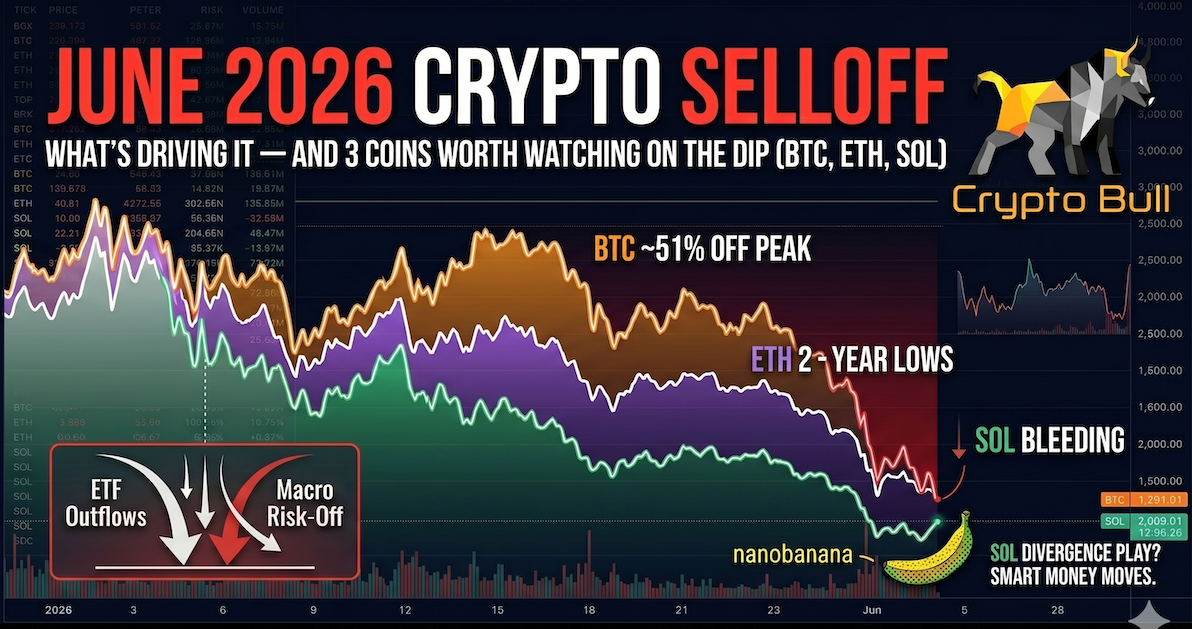
Major Market Updates in Crypto Summer Selloff 2026 - we have the drivers covered.
A direct word on risk: the bottom may not be in. ETH prediction markets are pricing a 70%+ chance of a deeper leg down before year-end, Solana just closed its longest losing streak on record, and Bitcoin remains in a confirmed downtrend. Anyone telling you this is a risk-free entry is selling you something. The case below is about what to accumulate if you're accumulating — not a promise the pain is over.
3 Coins Worth Watching on This Dip
1. Bitcoin (BTC) — The Anchor
Trading in the low-$60,000s and down ~51% from its peak, Bitcoin is the cleanest expression of this entire selloff — and the asset with the deepest liquidity, the strongest institutional infrastructure, and the longest track record of recovering from drawdowns of exactly this magnitude. The same ETF machinery driving outflows today is the machinery that drove the rally, and flows historically reverse within weeks of a macro shock. If you believe crypto recovers at all, BTC is the highest-confidence vehicle for that recovery. It's the foundation, not the moonshot.
Watch: a reclaim of the upper-$60Ks to confirm the flush is exhausting. Risk: continued ETF outflows and a stronger-for-longer dollar.
2. Ethereum (ETH) — The Deepest Value, the Highest Tension
At ~$1,735, ETH is down roughly 65% from its August 2025 high — the most beaten-down major in this cohort, and the most contested. The bear case is real: a record ETF-outflow streak, market share leaking to competitors, and prediction markets leaning bearish. But the bull case is equally concrete: ~30% of supply is staked and earning yield, ETH still anchors DeFi and tokenization, and the upcoming Glamsterdam network upgrade targeted for this year is a genuine catalyst that could spark a relief rally off oversold levels (14-day RSI recently near 28). This is the highest-risk, highest-asymmetry name of the three — cheapest relative to its history, but you're buying directly into the heaviest selling.
Watch: a sustained reclaim of $2,000 and Glamsterdam execution. Risk: the outflow streak continuing and the $1,500 level coming into play.
3. Solana (SOL) — The Divergence Play
SOL is near $69, its lowest since December 2023, after eight straight red monthly candles. On price alone, it looks broken. But here's the detail almost nobody is talking about: while Bitcoin and Ethereum ETFs hemorrhaged billions, Solana's spot ETFs just posted their best month of 2026 — roughly $15.6 million in net inflows last week alone, with total Solana ETF assets crossing $1 billion. That's institutional capital rotating into SOL during peak fear. Pair that with a network still doing tens of millions of daily transactions and billions in DeFi TVL, plus pending upgrades and a tokenomics proposal aimed at curbing dilution, and you have a name where the flows are quietly diverging from the price. That divergence is the entire thesis.
Watch: whether SOL holds the $65–$67 support shelf and whether ETF inflows keep building. Risk: as a high-beta asset, SOL amplifies every market-wide move — it'll fall harder if BTC breaks lower.
| Coin | Level (Early June '26) | The Thesis | Key Risk |
|---|---|---|---|
| BTC | ~$64K (-51% from peak) | Highest-confidence anchor; deepest liquidity; flows reverse fastest. | Continued ETF outflows, strong dollar. |
| ETH | ~$1,735 (-65% from peak) | Deepest value + Glamsterdam catalyst; highest asymmetry. | Record outflow streak; $1,500 in play. |
| SOL | ~$69 (low since Dec '23) | ETF inflows diverging from price; smart money rotating in. | High-beta; amplifies market-wide drops. |
The Bottom Line
The June 2026 selloff is driven by macro pressure, record ETF redemptions, and a leverage flush — not by anything broken in the underlying networks. That's exactly the kind of environment where disciplined accumulators have historically been rewarded and panic sellers have historically locked in losses.
If you're going to put capital to work, do it on quality, do it gradually, and size it so you can stomach more downside — because the bottom may not be in yet. BTC is the anchor, ETH is the deep-value tension trade, and SOL is the divergence play where the smart money is already moving against the price.
Fear is loud. Conviction is quiet. Plan accordingly.
This article is for informational and educational purposes only and does not constitute financial, investment, or trading advice. Cryptocurrency is highly volatile and you can lose your entire investment. Nothing here is a recommendation to buy or sell any asset. Always do your own research and consult a licensed financial professional before making any investment decision. Prices and data cited are as of early June 2026 and will change.