Hot Coin Alert: Why $OSMO at $0.067 Is a Coiled Spring on Cosmos Merger 2.0

At CryptoBull.org, we love when a real catalyst gets temporarily over-priced by traders and then sold back to where it started. That's exactly the setup $OSMO is offering right now.

In the last 48 hours, Osmosis has done something wild: it pumped 185% on revived Cosmos Hub merger speculation, hitting an intraday high of $0.1072, before retracing -36.8% back to $0.06748 as front-runners took profits.

The merger catalyst didn't disappear. The traders chasing it did.

This is the kind of post-pump dip where the underlying thesis hasn't changed but the price has cooled enough to offer a credible entry. Osmosis remains the dominant DEX in the Cosmos ecosystem, with $40B+ in lifetime trading volume, connectivity to 140+ blockchains via IBC, and one of the most asymmetric merger catalysts in DeFi sitting unresolved on the table.

Here's the breakdown.

The Thesis: A Real DEX Token With an Unresolved Catalyst

Osmosis isn't a new project chasing a narrative. It's been operational since 2021 as the primary liquidity venue for the Cosmos ecosystem β€” an appchain-native DEX that has facilitated over $40 billion in lifetime trading volume and connects more than 140 sovereign blockchains through IBC (Inter-Blockchain Communication).

The token got punished alongside the rest of DeFi through 2024–2025, falling 99%+ from its 2022 ATH of $11.21 to a March 2026 low of $0.029.

Then came the merger debate.

πŸ”₯ The Catalyst: The COSMOSIS Merger Saga (And Why It's Not Over)

Here's the timeline that matters:

  • March 11, 2026 β€” The COSMOSIS proposal is posted: convert all circulating OSMO to ATOM at a fixed rate of 1.998 OSMO β†’ 0.0355 ATOM over a six-month window.

  • April 2026 β€” Cosmos Hub governance narrowly rejects the proposal. Osmosis announces it will continue as "an independent, profitable blockchain."

  • May 11, 2026 β€” OSMO surges 185% in 24 hours as community members publicly float a revised proposal β€” potentially a hostile-takeover path where Hub governance drafts a new offer directly to OSMO holders.

  • May 12, 2026 (today) β€” Profit-takers exit. OSMO retraces -36.8% to $0.06748. Catalyst remains alive.

The key takeaway: the merger isn't dead β€” it's pending revival. The 185% pump confirmed that the market assigns meaningful probability to eventual integration. The 36% dump is traders cycling out, not the thesis breaking.

πŸ’Ž Why the DEX Itself Is the Floor

Even if the merger never happens, OSMO has real, defensible product-market fit that justifies the floor at current levels:

  • Multi-Chain DEX Hub: Primary liquidity venue for Cosmos; bridges to Ethereum, Solana, Avalanche, Polkadot, and Bitcoin.

  • 140+ IBC Connections: A cross-chain network effect that is nearly impossible to replicate.

  • Concentrated Liquidity: Capital-efficient pools comparable to Uniswap V3, but native to the appchain.

  • Smart Accounts + 1-Click Trading: UX features only possible because Osmosis owns the full chain stack.

  • Superfluid Staking: Stake AND provide liquidity simultaneously β€” yield on the same capital twice.

  • Profitable Operation: $5.5M in 2025 revenue against $550K in operating costs. Genuinely profitable DeFi infrastructure.

This is not a vapor token. This is a profitable DEX with real volume, real fees, and real users.
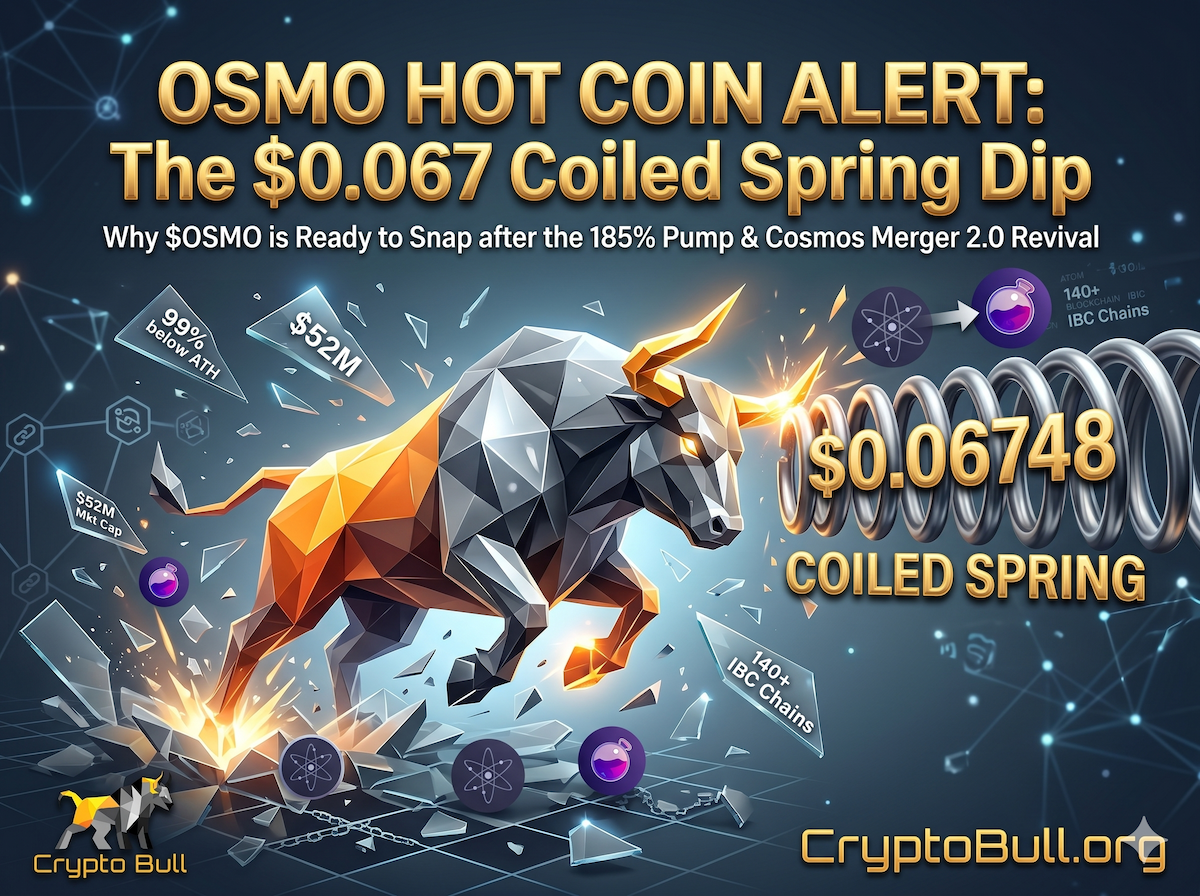
Crypto Bull analysis graphic for $OSMO at $0.067 following a post-Cosmos merger pump, highlighting a 'coiled spring' entry point.

$OSMO Coiled Spring Trade: The Post-Pump Dip Analysis

$OSMO Token: Real Utility, Not Governance Fluff

OSMO powers the network across four functions:

  • Gas & Transaction Fees: Every swap, stake, or vote pays in OSMO.

  • Staking & Security: Validators secure the proof-of-stake chain by staking OSMO.

  • Governance: Holders vote on protocol direction β€” including the next chapter of the merger debate.

  • Liquidity Incentives: Emissions reward LPs across the DEX's pools.

Supply: Circulating supply is ~773M of a 980M total (1B max). Most of the float is already unlocked, reducing the unlock-driven sell pressure that plagues newer tokens.

The Upside Case at $0.067

  • Price β€” $0.06748 (-36.8% in 24h): Still 99% below ATH of $11.21. Cooled off after a 185% pump β€” clean re-entry zone.

  • Market Cap β€” $52.4M: Tiny vs. peer DEX tokens. Uniswap, Curve, and PancakeSwap trade at 5–20x this valuation.

  • TVL β€” $18.7M: Real capital actively deployed in pools β€” not a synthetic number.

  • 24h Trading Volume β€” $88.5M: Volume ratio (~1.7x market cap) signals genuine market activity, not dead liquidity.

  • Lifetime DEX Volume β€” $40B+: Real product, real revenue history.

  • 24h Range β€” $0.06547 β†’ $0.1072: The range itself is the opportunity. You're buying at the bottom of yesterday's range.

If a revised merger proposal passes: the 1.998 OSMO β†’ 0.0355 ATOM conversion math implies a re-rate based on ATOM's price. At current ATOM levels, that's a meaningful premium to today's spot.

If the merger doesn't happen: you still own equity in the dominant multi-chain DEX in Cosmos at a $52M market cap β€” generating real revenue, with 140+ chains plugged in.

⚠️ The Risks β€” Read This Before You Buy

We don't sell hopium. Real risks at $0.067:

  1. Second merger attempt could also fail. Cosmos Hub governance already rejected this once. A revised proposal isn't guaranteed to clear.

  2. The 36% dump may not be done. If volume keeps fading and broader alts sell off, OSMO could revisit the $0.05 zone or even retest the March ATL of $0.029.

  3. Overhead resistance. Technical resistance sits in the $0.085 pivot and the broader $0.22–$0.30 zone. The current move has work to do before breaking structure.

  4. Cosmos ecosystem dependency. OSMO is tied to Cosmos's developer mindshare. If capital keeps rotating to Solana or Ethereum L2s, OSMO suffers downstream.

  5. Speculative bid is fragile. The 185% pump was front-running, not accumulation. Expect choppy price action until governance signals a real revised proposal.

The Bottom Line

$OSMO at $0.067 is a coiled-spring trade. You're buying after the speculative top blew off, but before the catalyst resolves. The downside is bounded by the underlying DEX business (real revenue, real users, real volume). The upside is asymmetric if merger 2.0 gets formally drafted.

This is a watchlist-and-scale-in setup, not a "back up the truck" buy. Position size accordingly. Watch governance signals from both Osmosis and Cosmos Hub. And do your own research.

Want More? Track our past hot coin calls and their performance on the Hot Coins Tracker.

Hot Coin Alert: Why $KITE (Now β‰ˆ0.07 USD) Could Be the Foundational Layer for the $240B AI Agent Economy

At CryptoBull.org, we are constantly sifting through the noise to find the next generation of crypto projects poised for massive growth. Today, we're spotlighting a token with an unparalleled pedigree and a vision that intersects the two hottest sectors in tech: AI and Blockchain.

The most compelling part? The $KITE token is currently trading at approximately $0.07 USD (check CoinMarketCap for the latest price), offering a potentially huge entry point for a project with this level of institutional backing and future-proof utility.

Get ready to soar with $KITE, the native utility token powering Kite AI and its mission to build the "Base Layer for the Agentic Internet."


The Thesis: AI Agents Need a Financial Brain to Unlock a $240B Market

The world is rapidly moving from a human-centric internet to an Agentic Internet, where autonomous AI agentsβ€”digital entities acting on our behalfβ€”will become the primary interface for digital commerce. Industry projections see this "agentic economy" unlocking a staggering $240 billion market within a decade.

But here's the problem: AI agents need a way to transact, prove their identity, and operate securely without constant human supervision. Current financial systems (credit cards, traditional banks) are too slow, too expensive, and too rigid for the high-frequency, millisecond-level micro-transactions that will define the machine-to-machine economy.

Kite AI is building the foundational solution.

The Kite Advantage: Institutional Backing Meets Blockchain Innovation

What sets $KITE apart is the confluence of a world-class team and massive institutional validation.


πŸ”₯ Elite Team & Funding

  • Top-Tier Talent: The Kite team boasts engineers and researchers from UC Berkeley, MIT, Harvard, Uber, Databricks, and Salesforceβ€”a group uniquely qualified in both large-scale distributed systems and applied AI.

  • $33M in Total Funding: Kite recently announced an $18M Series A round, bringing their total funding to an impressive $33M. The round was co-led by giants: PayPal Ventures and General Catalyst.

    • The PayPal Effect: PayPal Ventures' leadership signals a clear institutional belief that Kite is bridging the critical payment gap for the AI economy, leveraging stablecoin-based, millisecond-level settlement with low fees and no chargeback risks.


πŸ’Ž Core Infrastructure: Kite AIR

Kite's foundational product, Kite Agent Identity Resolution (Kite AIR), is the engine for the Agentic Internet, built on three foundational pillars:

  1. Cryptographic Identity (Agent Passport): Every AI model, agent, and dataset gets a unique, verifiable identity. This ensures traceability, provenance, and governance.

  2. Programmable Governance: Agents operate with built-in spending behaviors and delegated permissions, meaning they can't act "out of bounds."

  3. Instant Agentic Payment: Leveraging native access to stablecoins, agents can autonomously discover, negotiate, and pay for APIs, data, and services with near-zero fees and instant settlement.

Real-World Utility: Kite is already live with open integrations with major commerce platforms like Shopify and PayPal, enabling AI shopping agents to execute purchases with on-chain, traceable stablecoin payments. This is real adoption today, not a roadmap promise.


$KITE Token: The Fuel for the Agentic Economy


The $KITE token is not just a speculative asset; it is the native utility asset that powers every function within the Kite ecosystem, driving demand as the agentic economy grows.

  • Medium of Exchange: Agents use $KITE to pay for services on the network, such as API calls, data queries, and computational resources, through a "pay-per-request" micropayment model.

  • Staking & Security: Validators secure the network (a Proof-of-Stake chain) by staking $KITE.

  • Governance: Token holders get to vote on the future of the protocol.


Why $0.07 USD Gives $KITE Massive Upside Potential


The upside for $KITE is tied directly to the growth of the AI agent market it aims to serve.

MetricCurrent Status (β‰ˆ Nov 2025)Upside Potential ArgumentPrice$0.07 USD (Highly Volatile)A major infrastructure token trading well under $1.00 offers exponential growth potential if its technology is adopted as the industry standard.Market Capβ‰ˆ$134βˆ’$168M (Varies)For a project backed by PayPal Ventures and aiming at a $240B+ market, this valuation is incredibly low, suggesting massive room for appreciation as utility and trading volume mature.First-MoverBase Layer for Agentic InternetBecoming the default standard for AI agent identity and payment rails provides a colossal tailwind that could justify a valuation in the billions.

Export to Sheets

$KITE is an infrastructure play for the future of the internet. As the world races to build smarter AI agents, Kite is building the financial foundation they desperately need. This is a project that merits deep research and a spot on your high-potential watchlist.


Next Step: Since I've updated the post, would you like me to create the SEO-optimized title tag and meta description for it to maximize its search engine visibility?

The Case for Oyster Protocol (PRL)

Oyster Pearl (PRL)  is a coin that has been addressing the massive problem of out of control advertising on the internet. Ads are intrusive, annoying, and can often take up a large amount of bandwidth. Oyster Pearl addresses this by empowering website owners to earn revenue without displaying endless ads, while also providing file storage benefits as well. Visitors to these sites contribute a small portion of GPU and CPU which enables their files to be stored in a decentralized ledger, also rewarding website operators with revenue based on visitors and time spend on their site. The Oyster Protocol operates on top of the IOTA tangle and utilizes Ethereum smart contracts within their ecosystem as well. They have also introduced Oyster Shell (SHL) as a way to utilize new dapps and earn revenue on the Oyster meshnet, setting up nicely for future expansion of product offering.

Despite solid progress on roadmap, having already released their mainnet, the coin has taken a greater hit than most of the market in the recent bear turn down. PRL is currently trading at $0.14 USD on KuCoin, which is 1/30th of it’s January high of $4.38 USD. As Bitcoin shows early signs of a rally, keep an eye on PRL to rebound well if the progress continues.

Photo from www.thebitfeed.com

The opinions expressed on Crypto Bull are in no way financial advice and are only opinions. We are not responsible for any losses incurred as a result of reading our blog.