
Zcash: A US ETF and an EU Delisting Deadline
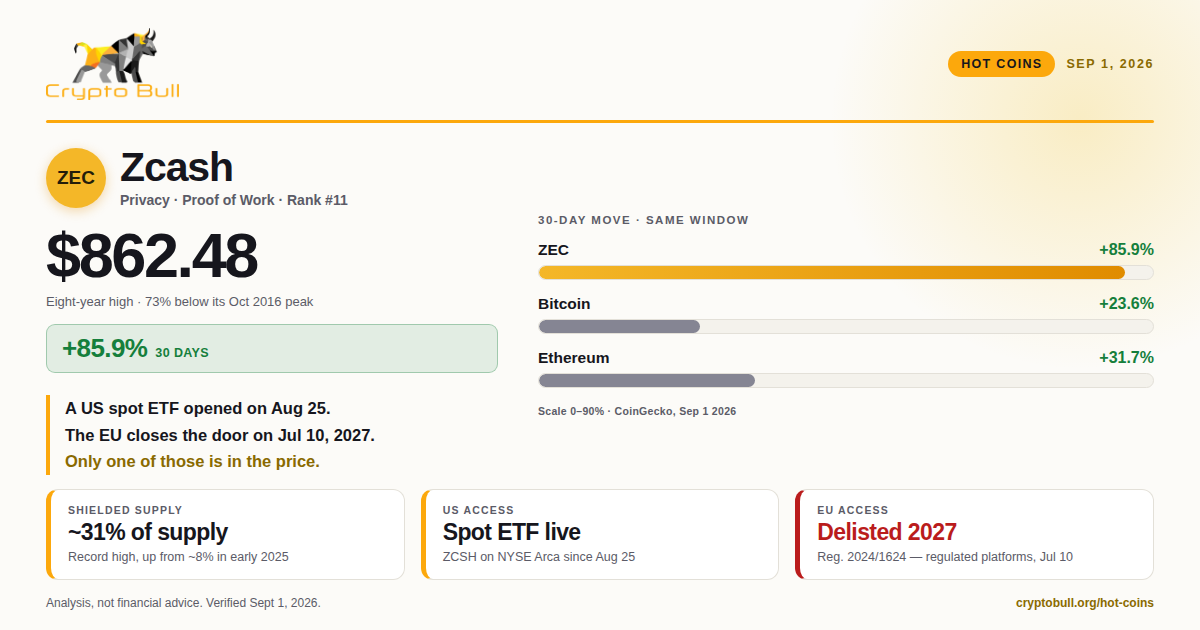
Zcash is up roughly 86% over thirty days and trading near an eight-year high. The proximate cause is verifiable: ZCSH, the first exchange-traded product in the world offering spot exposure to ZEC, began trading on NYSE Arca on August 25, 2026.
Over the same stretch, the other dated fact on Zcash's calendar did not move. Under EU Regulation 2024/1624, regulated platforms across the European Union must stop listing, custodying, or servicing Zcash from July 10, 2027. Monero and Dash are named alongside it.
This is analysis, not financial advice. Crypto assets are volatile and the majority of retail speculative accounts lose money over a full cycle; treat any single-asset thesis accordingly.
What a skeptic says first
There is no forward catalyst in this window. Say it plainly, because the last two Hot Coins post-mortems came from dressing a soft catalyst as a hard one. Ironwood activated on July 28. The ETF launched on August 25. The next halving is November 2028. The EU deadline is July 2027. Nothing on Zcash's calendar is scheduled inside the next two weeks. This is a "what changed and what it means" post, not a call ahead of an event.
The entry is at an eight-year high after an 86% month. Buying an asset that has nearly doubled in thirty days is a materially different proposition from buying the same asset in July. The tape underneath it is not supportive either: Bitcoin is down about 1.6% on the week and Ethereum down 0.9%, with hawkish Fed commentary pushing expectations toward a September hike and US August payrolls landing September 4. ZEC ran while the majors stalled. That divergence can close in either direction.
The EU rule is a forced seller with a date on it. Regulation 2024/1624 does not ban owning Zcash and does not touch self-custody or peer-to-peer use. What it does is require every regulated European exchange and custodian to retire the asset before July 10, 2027 or face penalties from AMLA. That is roughly twenty-two months of runway, and then a structural reduction in regulated venue access across an entire continent. Anyone modelling ZEC on ETF demand alone is modelling one side of a two-sided ledger.
The pool this asset's credibility rests on had a soundness bug, and the past cannot be fully audited. In late May 2026, researcher Taylor Hornby found an "infinity" flaw in the Orchard shielded pool's zero-knowledge circuit that "could theoretically have allowed an attacker to mint counterfeit ZEC without immediate detection." An emergency patch shipped in early June as NU6.2, and no evidence of exploitation was found. But the same privacy properties that make Orchard useful prevented developers from proving that hidden inflation never occurred. For a monetary asset, an unauditable supply history is not a small footnote.
Privacy is the product and also the liability. Zcash's entire thesis is that its shielded pool works. That makes it uniquely exposed to two things at once: a cryptographic failure, and a regulatory regime that treats the feature itself as the problem. Most assets carry one of those risks. This one carries both.
What Ironwood actually fixed
The response to the Orchard bug is the most substantive thing that has happened to this network in years, and it is not what the price coverage is about.
Ironwood is a new shielded pool that activated on July 28, 2026 at block 3,428,143 as network upgrade NU6.3. It runs its own note commitment tree, nullifier set, and chain value pool, and it introduces a public accounting checkpoint — a turnstile — that lets funds leave Orchard while making it impossible for more value to exit than legitimately entered. Researchers completed formal verification covering more than 2,700 theorems, confirming the new pool cannot create undetectable counterfeit coins under its stated cryptographic assumptions.
Orchard now accepts withdrawals only. As of August 24, migration had reached 85% complete, with roughly 3% of total supply still sitting in the old pool and Ironwood holding over 3.7 million ZEC.
Two caveats worth carrying. The formal verification covers soundness — it explicitly does not extend to Ironwood's privacy guarantees, which is a separate property. And the turnstile bounds future damage without retroactively auditing the Orchard era.
The data
Every return below is measured over the same window and pulled on September 1, 2026 from a single source, because an unbenchmarked number is not a number.
ZEC Benchmark Table:
| Asset | Price (1 Sep 2026) | 7-day | 30-day | All-time high | Below ATH |
|---|---|---|---|---|---|
| ZEC | $862.48 | +6.5% | +85.9% | $3,191.93 (28 Oct 2016) | -73.0% |
| Bitcoin | $77,773.08 | -1.6% | +23.6% | $126,080 (6 Oct 2025) | -38.3% |
| Ethereum | $2,453.69 | -0.9% | +31.7% | $4,946.05 (24 Aug 2025) | -50.4% |
ZEC outperformed both majors by a wide margin over thirty days and was the only one of the three positive on the week. It is also the only one of the three whose all-time high predates the current cycle by a decade.
A note on that all-time high, because the sources disagree and the gap is large. CoinGecko records $3,191.93 on October 28, 2016. CoinMarketCap and Coinbase both record $5,941.80 on October 29, 2016. Both are artifacts of Zcash's launch: the network went live on October 28, 2016 with almost no circulating supply, and the first prints came on essentially no liquidity. Neither figure represents a price at which a meaningful amount of ZEC changed hands. This post and the CryptoBull tracker use the CoinGecko figure, which is the tracker's stated convention and the more conservative of the two.
ZEC Supply and Issuance Table:
| Metric | Value | Source |
|---|---|---|
| Circulating supply | 16,847,427 ZEC | CoinMarketCap, Coinbase |
| Maximum supply | 21,000,000 ZEC (80.2% mined) | Protocol |
| Block reward | 1.5625 ZEC (2nd halving, Nov 2024) | Protocol |
| Daily issuance | 1,800 ZEC — 1,440 miners, 360 dev fund | Computed; matches Datawallet |
| Annual issuance | 657,000 ZEC — 3.90% inflation, ~$557M/yr | Computed |
| Vesting or cliff unlocks | None — mined asset, no vesting schedule | Protocol |
| Next halving | ~November 2028, block 4,406,400 | Protocol |
| Shielded supply | ~5.15M ZEC — ~31%, record high (8% early 2025) | Datawallet, 24 Aug 2026 |
The thesis
The interesting thing about Zcash right now is not that it went up. It is that two of the world's largest regulatory blocs have taken opposite positions on the same asset inside the same eighteen months, and the market is pricing one of them.
On August 25, Grayscale converted an existing trust into ZCSH and listed it on NYSE Arca — the first exchange-traded product anywhere offering spot exposure to Zcash. It came to market with $260 million in assets and reached $313 million by August 28. A privacy coin now has a regulated US wrapper that pension-adjacent money can hold.
Set that against Regulation 2024/1624, under which every regulated EU platform must delist Zcash by July 10, 2027.
Underneath both, the network's own numbers are moving in a direction that is harder to argue with. Shielded supply is at a record ~31% of circulating ZEC, up from roughly 8% in early 2025, and shielded transactions crossed 59% of all activity earlier this year. Hashrate is at a record ~17.2 GH/s. That is adoption of the actual feature, not just speculation on the ticker.
Here is the arithmetic that decides it. The network issues 657,000 ZEC a year — about $10.7 million of new supply every week at current prices. The ETF absorbed $53 million in its first three days. Three days is not a run rate and should not be treated as one, but at that pace early ETF demand is running several times weekly issuance. That, and not the privacy narrative, is what has been holding the price up.
What would falsify this. Three things, in order of how fast they would show up:
ZCSH flows stall or reverse. The entire near-term bid is one product a week old. If AUM flattens or bleeds over the next month, $10.7M of weekly issuance meets a market with no marginal buyer, and the 86% move retraces faster than it came. This is publicly reported daily — no interpretation required.
A second jurisdiction copies the EU. Regulation 2024/1624 is currently a European problem with a 2027 date. If a US, UK, or major Asian regulator signals the same treatment, the ETF thesis and the delisting thesis stop being separable and the asset reprices on access risk alone.
Another soundness finding, or a stalled migration. Roughly 3% of supply is still in Orchard, and the formal verification does not cover Ironwood's privacy properties. A second circuit bug in a pool whose whole purpose is verifiable soundness would do more damage here than an equivalent bug would to almost any other asset.
Any one of those and the position is wrong. We will say so here if it happens.
The track record
Hot Coins has run since 2017. The record is published in full — including the picks that went to zero — on the CryptoBull Hot Coins Tracker, which now carries 52 picks with an average all-time-high return of +1,475% from the original call date.
The headline entries: Chainlink at +4,796%, NANO at +4,603%, Helium at +3,990%, all measured from the date of the call.
ZEC enters at the low end. Its all-time high was set in October 2016 — ten years before this call — so the +276% figure in the tracker is distance to a decade-old peak, not an achieved return, and it drags the tracker average down by about 24 points. That is a materially different thing from LINK's number and it is worth saying plainly rather than letting the column imply otherwise.
Zcash is also not the first privacy asset in the table. Monero has been carried since January 2018. The category is old here; the ETF wrapper is what is new.
Last week's pick was BNB into the Pasteur hard fork — a protocol change with a confirmed on-chain result. This week's has no scheduled catalyst at all, which is stated at the top rather than buried.
This is analysis and not financial advice. CryptoBull is independent and takes no payment from projects covered. Digital assets are volatile and most retail speculative positions lose money over a full market cycle. Privacy assets carry an additional and specific risk that most assets do not: regulated venue access can be withdrawn by rule rather than by market forces, and in the European Union it already has been, effective July 10, 2027. Prices, supply figures and all-time highs in this post were verified on September 1, 2026 and will drift. Do your own research and size positions you can afford to lose entirely.