
AI agents made 138 million payments. The tokens made $69,094.
AI agents have made more than 138 million payments through the x402 protocol on Base, and the average time between a wallet being funded and making its first payment has fallen from 73 days in late 2025 to 18 minutes in the third quarter of 2026. Over roughly the same window, the monthly protocol revenue of Virtuals Protocol — the token most identified with agent commerce — fell from $14.49 million to $69,094.
Both of those things are true. This is the week to say why, and why CryptoBull is not taking a position in the sector.
What a skeptic says first
The usage figures come with caveats attached by the people who produced them. The 138 million figure is from Chainalysis research reported on October 14, and it covers only identifiable x402 transactions, not the whole agentic-payments market. Wallets that transacted on a single day were excluded. The researchers note that transaction counts alone do not establish genuine commercial demand, and that earlier work raised questions about artificial activity on the network. More than 87% of the analyzed payments fell between one-hundredth of a cent and ten cents.
So the honest version of the bull case is narrower than the headline: a very large number of very small payments, on one protocol, on one chain, with a real possibility that some share of it is not commerce.
Nothing here is a regulated instrument question. No enforcement action against Virtuals Protocol, Fetch.ai, iExec or Phala surfaced in this window. The week's regulatory items — the FCA's October 29 High Court settlement with HTX over unlawful UK promotions, the CFTC's October 27 suit against Utah, the UK Budget's proposed stablecoin tax treatment — touch none of these assets. The risk in this sector is not a regulator. It is that the thing being built does not need the tokens built alongside it.
The data
The sector's price action, benchmarked against BTC and ETH over the same window, November 3, 2026:
| Asset | Price | 7d | 30d | All-time high | Below ATH |
|---|---|---|---|---|---|
| VIRTUAL | $0.5795 | -4.59% | -26.47% | $5.07 (Jan 2, 2025) | -88.6% |
| FET | $0.1569 | -9.60% | -30.66% | $3.46 (Mar 28, 2024) | -95.5% |
| VVV | $22.28 | -11.96% | -19.93% | $34.26 (Sep 21, 2026) | -35.0% |
| BTC | $77,778 | -3.36% | -8.84% | $126,025 (Oct 6, 2025) | -38.3% |
| ETH | $2,281.19 | -1.37% | -15.54% | $4,946.50 (Aug 24, 2025) | -53.9% |
Every agent token in the table is down more than Bitcoin on the week and far more than Bitcoin on the month. The sector is not lagging the market. It is being sold into a falling market.
Then there is the part that is not about price. Virtuals Protocol publishes its fees and revenue on-chain, so the operating business can be read directly:
| Virtuals Protocol | Figure |
|---|---|
| Monthly revenue, Dec 2024 peak | $14,490,000 |
| Monthly revenue, Jul 2026 | $671,432 |
| Monthly revenue, Aug 2026 | $206,278 |
| Monthly revenue, Sep 2026 | $188,558 |
| Monthly revenue, Oct 2026 (partial) | $69,094 |
| Fees, trailing 30 days, all five chains | $271,959 |
| Revenue, trailing 30 days | $82,230 |
| Revenue, trailing 24 hours | $1,657 |
| Annualized revenue | $3,750,000 |
| Market cap | $379,430,000 |
| Market cap to annualized revenue | about 101x |
| Revenue paid to token holders, all periods | $0 |
| Total value locked | $0 |
| Supply not in circulation | 340.95M, 34.1%, no published vesting terms |
Revenue is down about 99.5% from the December 2024 peak and about 90% in the four months from July to October. In February the protocol announced a Revenue Network at Consensus Hong Kong, citing over 18,000 agents and "over $470M" of agentic GDP, and committing up to $1 million per month to agents selling services. Trailing thirty-day revenue is now $82,230. Those two numbers describe the same protocol eight months apart.
What could go wrong with this view
The usage could be real and the capture could arrive later. Infrastructure often monetizes after adoption. x402 is barely a year into meaningful volume, Visa, Mastercard and Stripe have backed it, and Coinbase has begun letting business customers accept payments from agents. A protocol with 138 million payments and no fee capture today is not obviously a protocol with no fee capture in 2028.
The revenue decline may be composition, not collapse. Virtuals' fee base shifted across five chains this year — Base, Solana, Ethereum, Robinhood Chain and Arc — and the protocol moved its cross-chain stack from LayerZero to Chainlink CCIP in June and went live on Arc in September. Some of the decline could be migration and launchpad seasonality rather than demand. The October figure is also a partial month.
The sell-off has a specific cause that is not about agents. An AI-sector sell-off tied to China on October 27 is itself cited as the driver of a 25% monthly fall in VIRTUAL. Layer on the Binance breach of October 29 — an estimated $6.3 billion, the largest on record, FBI-attributed to North Korea's TraderTraitor, more than $1 billion of long liquidations, roughly $3.64 billion of net outflows once withdrawals reopened — plus spot Bitcoin ETF outflows of $643.3 million on October 30 and $398.6 million on November 2. A sector can be down 30% in a month for reasons that have nothing to do with its own fundamentals.
And the counterfactual is uncomfortable. If agent payments settle in stablecoins, the asset that captures agentic commerce is USDC, and USDC has no upside to trade. That is a genuinely bearish conclusion for this entire token category, and it is the one the current data supports.
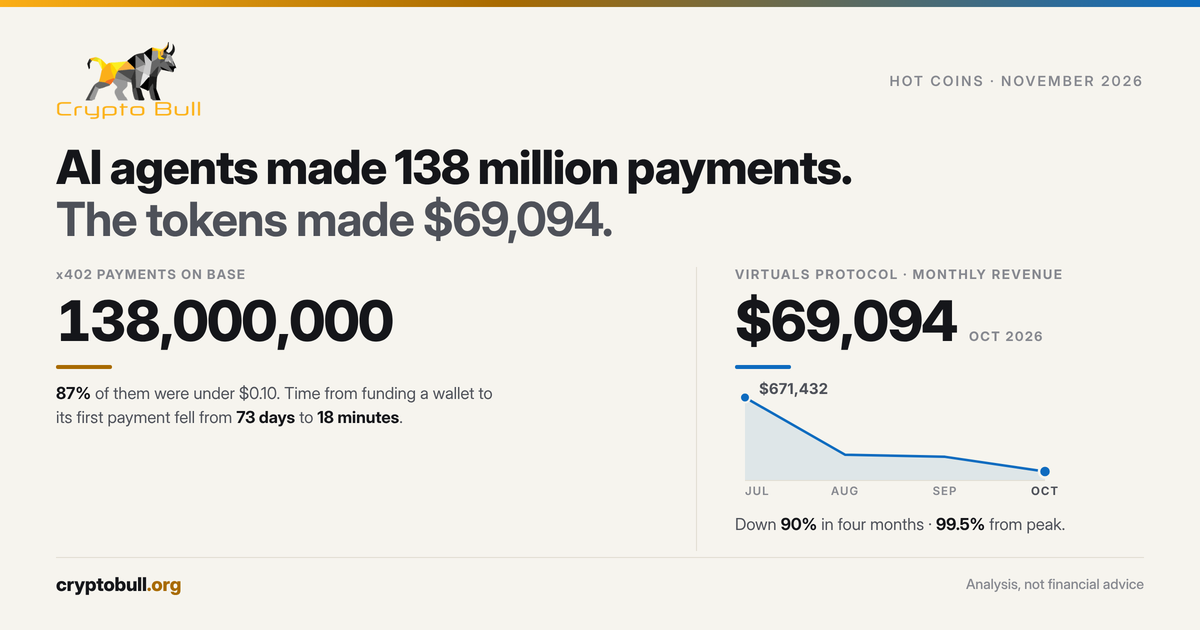
Chart contrasting 138 million x402 agentic payments on Base against Virtuals Protocol monthly revenue falling from 14.49 million to 69 thousand dollars
The thesis
Agentic payments are a real and fast-growing use case, and the listed tokens are not how you own it.
The evidence for the first half is the payment data: 138 million transactions, 87% of them under ten cents, and a collapse in time-to-first-payment from 73 days to 18 minutes. That last number is the one that matters, because it measures intent. Wallets are being funded in order to pay, immediately, rather than being funded and then finding a use.
The evidence for the second half is the settlement layer. The reference implementation of x402 runs on Base with Cloudflare operating the reference facilitator, identity handled by ERC-8004 on Ethereum, cross-chain movement via Circle's CCTP, and the payment asset is USDC. The agent frameworks plugged into it are Claude, the OpenAI Agents SDK, Gemini through Google's AP2, LangChain and CrewAI. In that entire stack there is no native token that must be bought for the system to work.
So the sector's tokens are selling a narrative that the infrastructure does not require. That is why revenue is falling while usage rises, and it is why the right position in agentic payments this week is no position.
What would falsify this. Three things, in order:
A token starts capturing x402 fees. If any listed asset in this category begins taking a measurable cut of agentic payment flow, and that shows up in on-chain revenue rather than a press release, the thesis inverts and it becomes the pick.
Virtuals' revenue turns. A close for November materially above October's $69,094 would mean the four-month decline was migration and seasonality rather than demand destruction. That is a checkable number on a dated schedule.
The payments data is shown to be real commerce. If the artificial-activity questions raised about x402 are resolved in the protocol's favor with attribution to identifiable commercial counterparties, the usage half of this post gets stronger and the sector deserves a second look at these prices.
Track record
The Hot Coins record runs to 59 picks with an average all-time-high return of +1,538% from the original call date, measured across the 56 rows where the high was reachable after the call. Every call date and live price is in the Hot Coins Tracker.
No row is being added this week. The tracker exists to measure calls, and a pass is not a call. Adding a row for a no-position post would corrupt the one statistic the franchise is built on. Weeks where the honest answer is "nothing here" are part of how that average survived nine years.
For the version of this analysis where the numbers did support a position, the unlock work in last week's Falcon Finance unlock analysis is the template, and the AI-infrastructure thesis is set out in the earlier Kite AI pick.
This is analysis and not financial advice