
Cronos Is Voting to Burn CRO While 1.17B a Month Vests Out
Cronos governance closes voting on Proposal #37 on October 3 at 02:02 UTC. It would direct 100% of revenue from two new products into buying CRO on the open market and burning it — and it lands while the Strategic Reserve releases roughly 1.1667 billion CRO every month until March 2030.
Both of those are verified. Whether the first is larger than the second is the only question that matters, and the proposal does not answer it.
The governance history is the risk, and it is specific. In 2021 Crypto.com burned 70 billion CRO, describing it at the time as the largest token burn in history. In March 2025 a proposal reversed it, reissuing all 70 billion into a Strategic Reserve and returning total supply to 100 billion. It passed over vocal community opposition, with Crypto.com-linked validators controlling roughly 70% of the voting power. Independent validators opposed it and could not block it. CRO fell about 8% that week, to around $0.079.
That is the same validator set now voting on a burn proposal. Proposal #37 requires 33.4% of bonded CRO to participate and more than 50% voting Yes. A governance process that could pass an unpopular 70-billion-token supply increase can pass a popular burn; the question a skeptic asks is what the vote actually demonstrates about token holder power either way.
The vest is continuous, not a cliff. The Strategic Reserve vests linearly from 18 March 2025 to 18 March 2030, monthly, at approximately 1.1667 billion CRO per epoch. Against 49.751 billion circulating, that is 2.345% of the float every month — roughly $81.4 million at today's price, and about 28% of the current circulating supply per year. There is no unlock date to mark on a calendar because it never stops.
The proposal publishes no revenue figures. Ult launched September 17, 2026 and Cronos Launch launched September 15, 2026. Neither has meaningful operating history, and the proposal gives no revenue projections, no burn estimates, no drawdown limits and no sustainability timeline for the reserve. "100% of revenue" is a percentage of an unpublished number.
The supply cap may not be a cap. CoinGecko and CoinMarketCap both publish a 100 billion maximum supply. TokenRadar reports that supply on Cronos POS is inflationary and unbounded, with total supply set to null. Those cannot both be right, and it is not resolvable from public aggregator data.
CRO: the burn against the vest
| Flow | CRO | Value at $0.06975 | Frequency | % of 49.75B float |
|---|---|---|---|---|
| Strategic Reserve vest | 1,166,700,000 | $81.4M | Monthly to Mar 2030 | 2.345% |
| Latest burn (fifth) | 228,000,000 | $15.9M | One-off | 0.458% |
| All five burns to date | 428,000,000 | $29.9M | Cumulative | 0.860% |
The comparison the proposal does not make: the 228 million burn is 19.5% of a single month's vest. Every burn Cronos has ever executed, added together, comes to 36.7% of one month's vest.
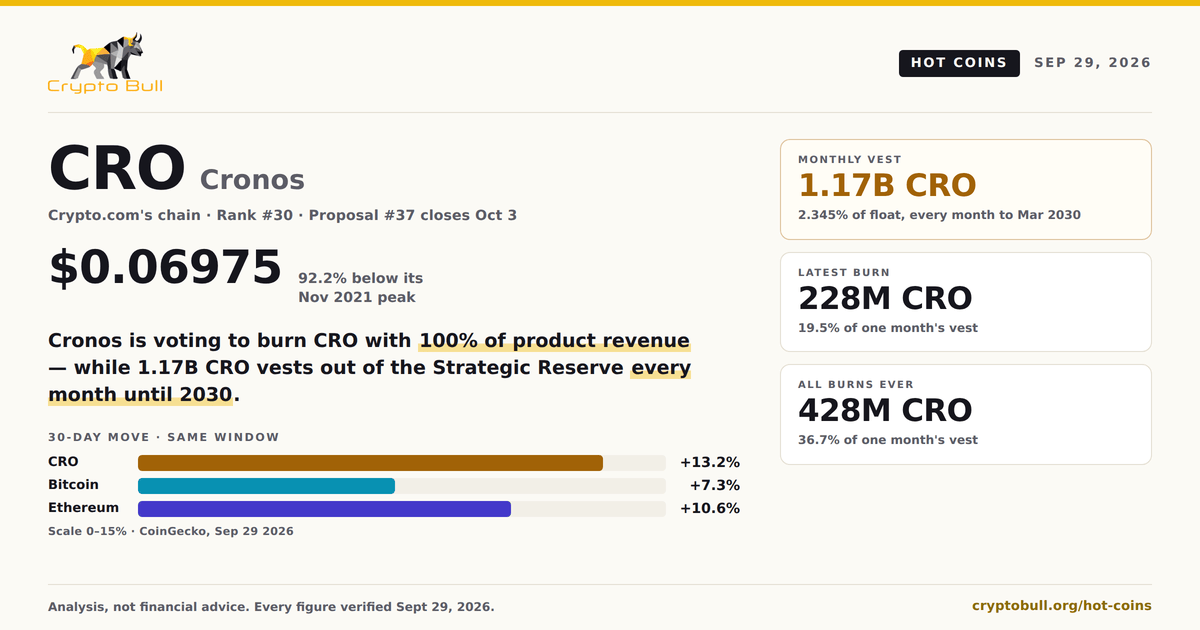
Cronos CRO supply chart contrasting the 228 million token burn with the 1.1667 billion CRO released monthly from the Strategic Reserve through March 2030
CRO Benchmarked against BTC and ETH, same window:
| Asset | Price | 7 days | 30 days | 1 year | Below own ATH |
|---|---|---|---|---|---|
| CRO | $0.06975 | +5.2% | +13.2% | +63.4% | 92.2% |
| BTC | $83,767 | -1.7% | +7.3% | +25.1% | 33.6% |
| ETH | $2,728.73 | -1.3% | +10.6% | +34.4% | 44.8% |
CRO has outrun both benchmarks on every window in the table — 5.2% against negative weeks for BTC and ETH, 13.2% against 7.3% and 10.6% over thirty days, 63.4% against 25.1% and 34.4% over a year. It is also 92.2% below its own all-time high, against 33.6% for Bitcoin and 44.8% for Ethereum. Those two facts describe an asset that has been recovering hard from a very deep hole, not one that has proved anything.
The bull case is mechanical rather than narrative: if Ult and Cronos Launch generate real revenue and 100% of it goes to open-market buying and burning, the burn eventually offsets some part of a 2.345%-per-month vest. Cronos also runs the burn on-chain with published transaction hashes, which makes the claim checkable rather than announced — that is genuinely better practice than most buyback programmes.
The bear case is arithmetic. At current scale the burns are not close. 228 million against 1,166.7 million a month is not a rounding error in the right direction; it is a fifth of one month's supply, once. For the mechanism to matter, revenue from two products that are under two weeks old has to grow by roughly an order of magnitude and stay there for four and a half years.
What would falsify the thesis. Three things, in the order they would show up:
The vote fails to reach 33.4% quorum, or passes without disclosed revenue. A burn programme with no published revenue baseline cannot be audited even with on-chain hashes, because you can verify what was burned but not what should have been. If Proposal #37 passes and no revenue figures follow within a quarter, treat the programme as unsized.
Monthly burns stay below ~1.17 billion CRO. That is the break-even line against the vest, and it is a number anyone can check on-chain each month. The entire history of Cronos burns to date is 428 million. If burns are not clearing a billion a month within a year, the mechanism is cosmetic.
Governance concentration reasserts itself against holders. The March 2025 reversal is the precedent. If the same validator concentration is used to amend or unwind the burn commitment once revenue becomes material, the on-chain transparency does not protect anyone.
What would not falsify it: CRO trading down through the vote. A four-day-ahead governance deadline is a known date, and single-session moves around known dates carry very little information.
CryptoBull has published 55 Hot Coins picks since 2017. Across the 54 that are comparable, the average all-time-high return from the call date is +1,504.7%. Every call is listed with its date and entry price on the Hot Coins Tracker, including the ones that went to zero.
CRO has appeared once before, and that row is the standing example of a call the tracker refuses to score. It was called on 17 December 2017 as Monaco (MCO) at $12. MCO was swapped to CRO in 2020 at a fixed ratio, which changed the denomination and made the return math meaningless — so that row carries excludeFromStats and renders "n/a — token swap" rather than a percentage. It is not evidence for or against this call and should not be read as either.
This entry is a fresh, comparable call: CRO at $0.06975 against a verified all-time high of $0.8915 from 24 November 2021 — an ATH return from call date of +1,178.1%. Adding it moves the tracker average from +1,504.7% to +1,498.7%, because it sits below the current mean. We publish the number that comes out, not the one that reads better.
Related reading: Plasma XPL: unlock and insider supply risk and Cardano ADA ETF eligibility catalyst.
This is analysis, not financial advice