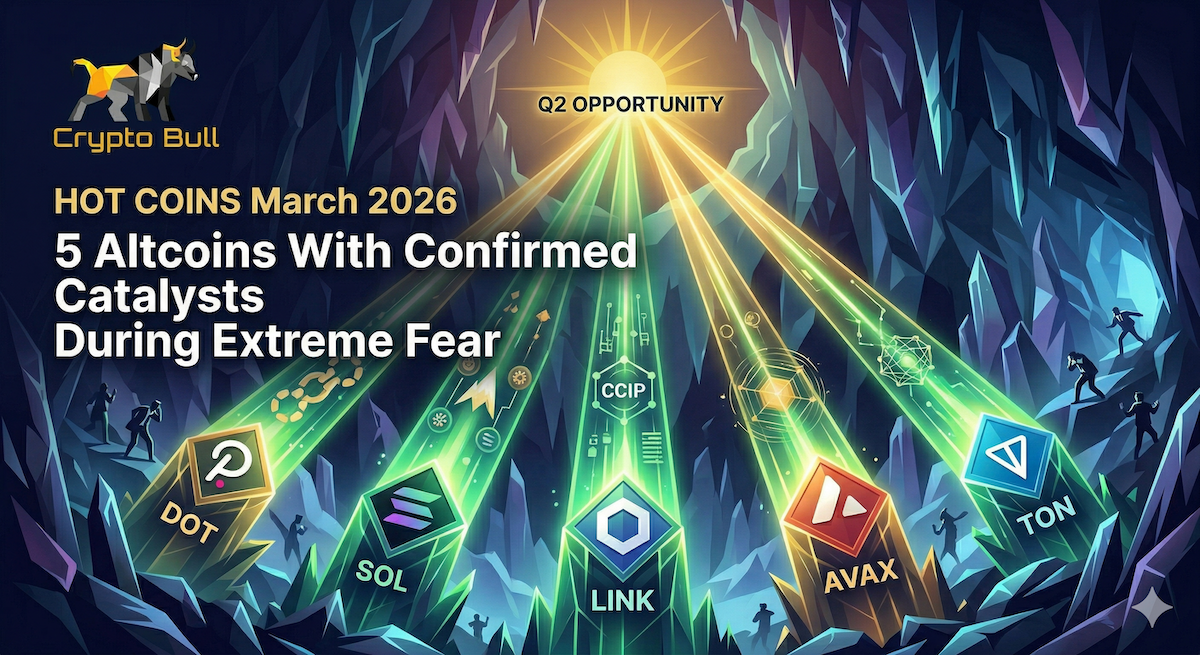
Hot Coins March 2026: 5 Altcoins With Confirmed Catalysts During Extreme Fear
The crypto market is deep in fear territory. The Fear & Greed Index sits at 15 — Extreme Fear. Earlier this month it hit 5, dropping below both the COVID crash and the FTX implosion readings. Bitcoin has corrected more than 50% from its October 2025 all-time high near $126,000, currently trading around $71,000. Altcoins have been hit even harder — many are down 80–95% from their cycle peaks.
But here's the thing about extreme fear: it's where the best risk-reward setups emerge. Not from blind dip-buying, but from targeting projects with concrete, date-specific catalysts and strong on-chain fundamentals.
This month's Hot Coins aren't memecoins or hype plays. They're established networks with confirmed upgrades, growing adoption, and real infrastructure value. Here are our 5 picks for March 2026.
1. Chainlink (LINK) — The Infrastructure Play
Current Price: ~$9.05 ATH: $52.70 (May 2021) — down 83% Market Cap: ~$6.1B Why Now: Commodity classification, ETF momentum, and CCIP expansion
Chainlink is the connective tissue of DeFi. Its oracle network and CCIP protocol power cross-chain interactions for some of the largest institutions in traditional finance.
Several major developments have landed in recent months. The SEC and CFTC reportedly classified LINK as a digital commodity — a significant regulatory clarity moment that reduces legal uncertainty and could broaden institutional access. U.S. spot Chainlink ETFs launched in late 2025 have recorded zero outflow days for over 75 consecutive trading sessions, signaling sustained institutional demand. And Q1 2026 revenue reached approximately $14.6 million, indicating real and growing network usage.
On the partnership front, Chainlink's collaboration with Intercontinental Exchange (the company behind the NYSE) to enhance oracle infrastructure signals deep institutional trust. The CCIP expansion roadmap for 2026 includes new chain integrations and enterprise partnerships. Meanwhile, the RWA (real-world asset) tokenization narrative — which hit $11 billion in total value — runs directly through Chainlink's infrastructure. Every tokenized bond, every cross-chain transfer, every price feed touches LINK's network.
In January 2026, Chainlink acquired Atlas to accelerate its MEV tool rollout, and in December 2025, the first U.S. Chainlink ETF launched on the NYSE.
CryptoBull's take: LINK at $9 is 83% below its all-time high, but the fundamentals have never been stronger. Commodity classification, ETF inflows with zero outflow days, and growing revenue make this one of the most fundamentals-backed altcoins in the market. The discount is extreme relative to the utility.
2. Solana (SOL) — Alpenglow Changes the Game
Current Price: ~$90 ATH: ~$260 (Nov 2025) — down ~65% Market Cap: ~$44B Why Now: Alpenglow consensus upgrade, ETF milestone, institutional treasury adoption
The Alpenglow upgrade — being developed by Anza, a Solana Labs spinoff — is the most significant architectural change to Solana since launch. Alpenglow introduces two new components: Votor, targeting 100–150 millisecond block finality (currently ~400ms), and Rotor, a more efficient data propagation system replacing Turbine. If delivered, this makes Solana arguably the fastest production blockchain in existence. No confirmed launch date yet, but the upgrade could be a major catalyst once it ships.
Institutional adoption milestones are stacking up. Spot Solana ETFs — including Bitwise (BSOL) and Fidelity (FSOL) — have surpassed $1 billion in total assets. Morgan Stanley has filed for its own Solana Trust. Forward Industries (NASDAQ: FORD) has converted its treasury strategy to hold over 6.9 million SOL (valued at just under $1 billion) and now operates its own validator node. In September 2025, Galaxy Digital partnered with Superstate to tokenize its SEC-registered Class A Common Stock directly on the Solana blockchain.
The Solana Foundation also recently launched a new privacy framework targeting institutional adoption — a direct play for enterprise capital that has historically been cautious about public blockchain transparency.
The ecosystem hasn't slowed down during the correction either. Jupiter remains the dominant DEX aggregator, and on-chain activity metrics (transactions, active addresses, DEX volume) continue to outpace most L1 competitors.
CryptoBull's take: SOL at $90 is a fundamentally different proposition than SOL at $200. The Alpenglow catalyst hasn't been priced in, ETF inflows are building institutional floors, and a public company is running a validator with nearly $1B in SOL. This is a high-conviction pick for a 6–12 month time horizon.
3. Toncoin (TON) — Telegram's 800 Million User Moat
Current Price: ~$1.31 ATH: ~$8.25 (Jun 2024) — down ~84% Market Cap: ~$3.2B Why Now: Telegram integration and distribution advantage at a deep discount
Most L1 blockchains struggle with user acquisition. Toncoin doesn't have that problem. Its integration with Telegram gives it immediate access to over 800 million monthly active users — a distribution channel no other blockchain comes close to matching.
TON's ecosystem has expanded rapidly: mini-apps built on the Telegram platform are driving real on-chain activity, and the wallet integration makes crypto accessible to people who've never used a blockchain before. The network has crossed several milestones in transaction volume and active addresses.
We need to be direct: TON has been hit harder than most in this correction, dropping from over $8 to $1.31. That's a brutal drawdown, and it reflects both the broader market selloff and specific concerns about execution. The thesis here is purely about the distribution moat — 800 million Telegram users is an asset no other chain can replicate. At $1.31, you're buying at a level that prices in significant pessimism.
CryptoBull's take: This is the highest-risk pick on the list. The distribution advantage is real and unmatched, but the price action is telling you the market has doubts about monetization and ecosystem depth. Only appropriate for investors who can hold through further downside and believe Telegram's crypto integration will eventually convert users into on-chain activity at scale. Position size accordingly.
4. Avalanche (AVAX) — Institutional-Grade Subnets With ETF Backing
Current Price: ~$9.50 ATH: $144.96 (Nov 2021) — down ~93% Market Cap: ~$4.1B Why Now: First spot AVAX ETF with staking, RWA tokenization surge
Avalanche's subnet architecture lets institutions and enterprises launch custom blockchains with their own rules, validators, and compliance requirements — all while leveraging Avalanche's security and interoperability. This positions AVAX uniquely in the RWA tokenization boom.
In January 2026, VanEck launched the first U.S. spot AVAX ETF (VAVX), which includes staking rewards for investors — a first for crypto ETFs. This creates a new, steady demand channel: ETF inflows directly increase buy-side pressure for the underlying AVAX token.
Real-world asset tokenization on Avalanche has surged, with TVL doubling since April 2025 to approximately $2.1 billion, driven by institutional pilots. The Granite upgrade (live on testnet in October 2025) introduced dynamic block times and improved cross-chain messaging, enhancing network performance for enterprise use cases.
CryptoBull's take: AVAX at $9.50 is a 93% discount from its all-time high. A functioning spot ETF with staking, $2.1B in RWA tokenization TVL, and a subnet model that solves real institutional compliance needs — all at sub-$10. The risk is competitive pressure from Solana, Base, and modular ecosystems. But at this price, the institutional narrative has room to play out.
5. SUI — Move Language, Deep-Value Territory
Current Price: ~$0.96 ATH: ~$5.35 (Jan 2025) — down ~82% Market Cap: ~$2.9B Why Now: Ecosystem growth and developer momentum at sub-$1 prices
SUI has broken below $1, putting it firmly in deep-value territory for anyone who believes in the Move language thesis. Built on the Move programming language (originally developed at Meta), SUI's architecture allows for parallel transaction processing, which gives it significant throughput advantages over traditional EVM chains.
On-chain metrics tell the story even during the correction: active addresses and transaction volumes have been climbing. DeFi TVL on SUI has grown substantially, with lending protocols and DEXs attracting liquidity. The developer community is expanding, and SUI's grant programs continue to attract builders migrating from other ecosystems.
The Move language ecosystem (SUI + Aptos) is gaining developer mindshare as a credible alternative to Solidity/EVM. This is a long-term structural trend, not a one-quarter narrative.
CryptoBull's take: SUI under $1 is either a generational entry or a value trap — and we lean toward the former given the on-chain activity trends. But the risk is real. This is earlier in its growth curve than SOL was at a similar stage, which means higher upside potential but also higher execution risk. Only appropriate for portfolios that can absorb further downside. Small position, long time horizon.
How to Think About These Picks
The correction has been deeper than most expected. BTC is down roughly 50% from its October ATH, and altcoins are down 80–95% in many cases. This is the kind of environment where future returns are made — but only if you can stomach the volatility and avoid over-leveraging.
A few principles for navigating extreme fear markets:
Don't go all-in. Dollar-cost averaging works. Spread your entries over weeks, not one lump sum. Nobody knows if the bottom is in.
Prioritize catalysts over narrative. Every altcoin has a "story." These five have confirmed technical upgrades, institutional partnerships, ETF products, or structural growth drivers that exist regardless of market sentiment.
Size your positions to your conviction. LINK and SOL are lower-risk given their established ecosystems, ETF products, and institutional backing. AVAX sits in the middle with a new ETF and growing RWA traction. TON and SUI carry more execution risk but have higher upside from these levels.
Set your time horizon. These aren't day trades. If you're entering during extreme fear, give the thesis 6–12 months to play out. Every prior period of Fear & Greed Index readings this low — late 2022, COVID crash — preceded significant recoveries within months.
Manage your risk. The most important trade in a bear market is the one that doesn't blow up your portfolio. Keep positions sized so that a further 50% decline in any single coin doesn't materially damage your financial health.
Track live market data, sentiment indicators, and price action for all of these coins at CryptoBull Insights.
The opinions expressed on CryptoBull.org are not financial advice. We are not responsible for any losses incurred as a result of reading our blog. Always do your own research.
Follow us on X: @BlogBull