
Maple Finance (SYRUP) Deep Dive: Institutional On-Chain Credit and the RWA Lending Opportunity in 2026
What Is Maple Finance?
Maple Finance is an institutional-grade, decentralized corporate debt marketplace built on Ethereum and Solana. It sits at the intersection of traditional finance (TradFi) and DeFi — enabling institutional borrowers to secure tailored financing (both undercollateralized and overcollateralized) while giving lenders access to sustainable, premium yield backed by real credit underwriting.
This is not a retail yield farm. Maple is building on-chain capital markets infrastructure.
The Team
Maple was founded in 2019 and launched in 2021. Leadership is anchored by traditional finance operators with verifiable track records:
Sidney Powell (Co-Founder & CEO) — Prior to Maple, participated in over $3B in corporate bond issuance and managed a $200M+ bond funding program at a commercial lending FinTech.
Joe Flanagan (Co-Founder & Executive Chairman) — Deep background in financial operations and strategy.
Matt Collum (CTO) and Ryan O'Shea (COO) round out the core team.
The broader team includes alumni from J.P. Morgan, Bank of America, Deutsche Bank, BlackRock, and PIMCO. This is not an anonymous dev team — it's a protocol built by credit professionals for institutional adoption.
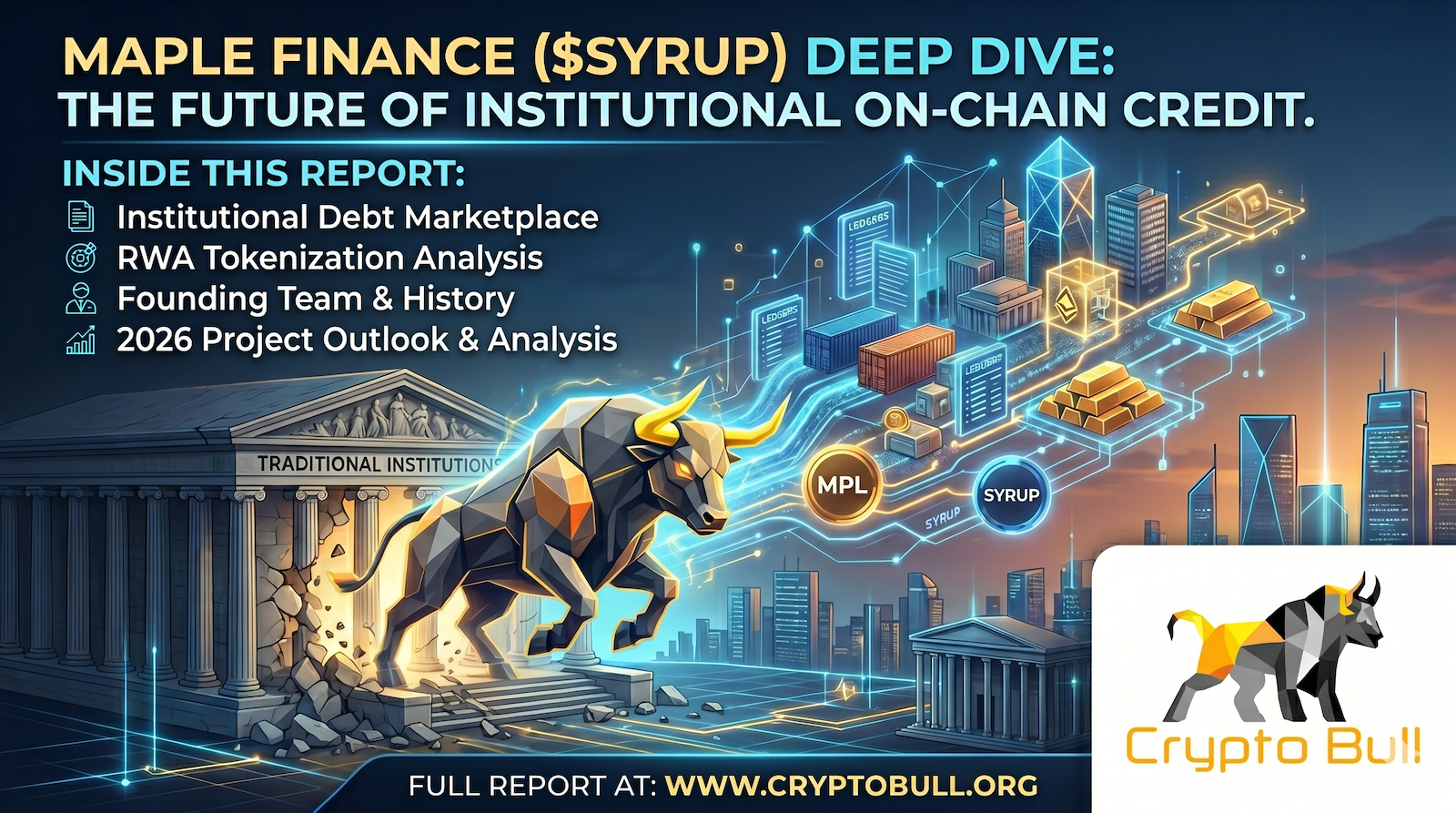
Cryptobull makes a strong case for Maple Finance’s $SYRUP token
How Maple Got Here: The 2022 Stress Test
Maple launched into the 2021 bull market as a leader in uncollateralized institutional lending. The 2022 crypto collapse exposed its early weakness: bad debt from over-leveraged trading firms caught in the deleveraging spiral.
Rather than folding, Maple rebuilt. The team overhauled risk management, tightened underwriting standards, and pivoted aggressively into Real-World Assets (RWAs) and secured institutional lending. That pivot is what defines Maple today.
Current State (Early 2026)
Maple has emerged as one of the dominant protocols in the RWA and on-chain credit sector. Key developments:
Dual-token ecosystem: Legacy MPL (governance) and SYRUP (yield-bearing, protocol growth-linked)
Yield products: syrupUSDC and syrupUSDT — transparent, overcollateralized lending returns
Tier-1 integrations: Aave V3 (SYRUP listing targeted), Coinbase, Binance
Permissioned secured lending pools for sophisticated allocators
Market Opportunity
The macro narrative is clear: institutional capital is moving on-chain, and RWA tokenization is the bridge.
Maple's structural edge is capital efficiency. Traditional DeFi requires overcollateralization — borrowers lock up more than they borrow. Maple's model allows institutions to borrow against off-chain reputation, verifiable financial health, or specific secured collateral. That unlocks real credit flow into the digital economy in a way overcollateralized protocols simply cannot replicate.
The addressable market for tokenized assets is projected in the trillions. Maple is positioned at the intake valve.
$SYRUP Token Data Snapshot (April 2026)
| Metric | SYRUP |
|---|---|
| Price | ~$0.248 |
| 24H Volume | ~$17.75M |
| Market Cap | ~$288.9M |
| CMC Rank | #117 |
| Circulating Supply | ~1.16B of 1.21B total |
Supply note: With ~96% of tokens already in circulation, the risk of future unlock-driven sell pressure is significantly reduced compared to early-stage token structures.
The Bull Case
RWA lending is one of the highest-conviction macro theses in crypto right now
Maple has survived a real stress test and emerged with stronger risk infrastructure
SYRUP tokenomics tie holders to protocol fee growth — not just governance optics
Regulatory clarity on stablecoins and tokenized securities directly benefits compliant, institutionally-focused protocols like Maple
Bottom line: Maple Finance is infrastructure, not speculation. For investors building a high-conviction RWA position, it warrants serious due diligence.
Sources
CryptoBull.org publishes independent research and market analysis. Nothing here is financial advice. Always conduct your own research before making investment decisions.