
io.net's October 11 Unlock: 3.45% of Float in a Single Day
io.net releases 14,140,000 IO tokens on October 11 — 3.45% of circulating supply in a single day, the largest percentage dilution in this week's unlock window. At $0.1683 that is roughly $2.38 million against a $69 million market cap, and it lands on a token where 48.7% of total supply has still never reached the market.
Start here, because the risk is the story.
Locked supply is the real overhang, not this unlock. 389,748,372 IO — 48.7% of the 800 million max supply — remains locked. At today's price that is $65.6 million of future supply queued against a $69.1 million market cap. The October 11 release is 3.45% of float; the remaining schedule is roughly 95% of it, running through 2030.
io.net uses cliff vesting on its Emissions allocation. Tokens release all at once after a waiting period rather than streaming daily. Cliff schedules concentrate selling pressure into single dates, which is why a 3.45% release can transmit to price in a way that a 0.1% daily drip does not.
No recipient split is published for this release. Aptos, by contrast, publishes a four-way breakdown for its October unlock. Without a split, there is no way to distinguish tokens going to a foundation treasury that will sit from tokens going to early backers with a cost basis near zero. Treat the whole 14.14M as potentially liquid until io.net says otherwise.
Forward schedule beyond October is unconfirmed. Public trackers agree on the October 11 date and amount and disagree or go silent on November and December. Anyone telling you the next three months of io.net emissions with confidence is reading a paywalled estimate.
Regulatory context: nothing newly dated. No io.net-specific enforcement action was found. The live regulatory item for the sector is the SEC's proposed Regulation Crypto Assets, whose comment period closes October 20, 2026 — a sector-wide rulemaking, not an io.net matter.
The Unlock, by Denominator
| Denominator | Supply base | 14.14M IO as a share |
|---|---|---|
| Circulating supply | 410,251,628 IO | 3.45% |
| Total supply | 797,744,000 IO | 1.77% |
| Max supply | 800,000,000 IO | 1.77% |
| Market cap | $69,055,345 | 3.45% |
| 24-hour volume | $20,652,147 | 11.5% — about 2.8 hours of average volume |
The same unlock is honestly describable as 3.45% or 1.77% depending on which supply base you divide by, and most coverage will not tell you which it picked. This week offers a clean worked example. Aptos unlocks 11,310,000 APT on October 11. Divide by circulating supply and it is 1.30%. Divide by max supply and it is 0.54%. One widely syndicated write-up reported 0.64%, which requires a "released supply" of 1.77 billion APT — a figure that CoinGecko, CoinMarketCap and Tokenomist all contradict, each reporting 871.3 million circulating against a 2.1 billion cap.
Use circulating supply. It is the only denominator that answers the question a holder is actually asking: how much new sellable supply arrives relative to what already trades.
| Asset | Price (Oct 6, 2026) | All-time high | Drawdown from own ATH | Supply still locked |
|---|---|---|---|---|
| io.net (IO) | $0.1683 | $6.43 (Jun 12, 2024) | -97.4% | 48.7% |
| Bitcoin (BTC) | $86,147.96 | $126,080 | -31.8% | Issuance by halving schedule |
| Ethereum (ETH) | $2,680.92 | $4,946.05 | -45.2% | No lockup; net issuance near flat |
The thesis is narrow: at a $69 million cap with $20.7 million of daily volume, a $2.38 million unlock is absorbable, and the market has already priced the dilution path. IO is down 97.4% from its June 2024 high while BTC is down 31.8% and ETH 45.2% from theirs. That gap is not a mystery — it is 28 months of scheduled emissions arriving into a thinner bid. A token that has already given back 97% of its peak is not repricing on 3.45% of float unless something else is wrong.
The $2.38 million release clears in roughly 2.8 hours of average volume. That is the number that matters, and it is the reason this unlock is a risk note rather than an event.
What would falsify this:
Volume falls before October 11. The 2.8-hour absorption figure assumes $20.7M daily. If volume halves into the unlock, absorption time doubles and the release starts to bite. Check 24-hour volume on the morning of the 11th, not today.
io.net publishes a recipient split weighted to early backers. A release that is mostly foundation treasury behaves differently from one that is mostly investors at a near-zero basis. A split disclosure skewed to the latter breaks the absorbability argument.
A November or December cliff lands materially larger than 14.14M. The forward schedule is unconfirmed. If the next tranche is a multiple of this one, October stops being the story.
Price breaks below the $0.09298 all-time low. That would say the dilution is not priced in, it is still being discovered.
CryptoBull has published 57 Hot Coins picks since 2017, tracked openly with entry price, all-time high and current price on every row — including the ones that went to zero. The franchise's best calls from their original call dates: LINK +4,796%, NANO +4,603%, HNT +3,990%.
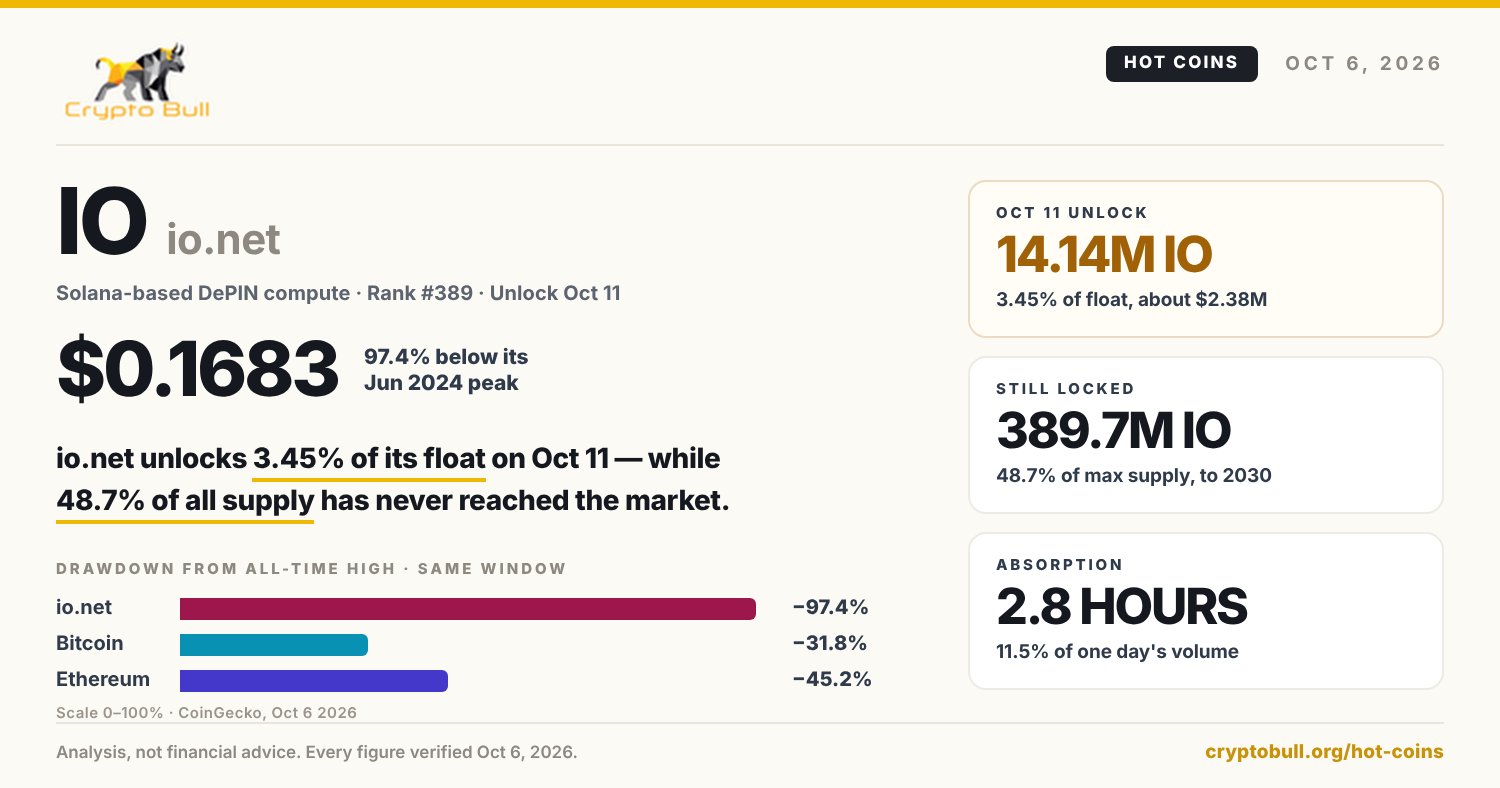
io.net IO token unlock chart showing 14.14 million tokens releasing October 11, 2026 against 410 million circulating supply
Full history, sortable and updated live: CryptoBull Hot Coins Tracker
Related: Plasma (XPL): Unlock Mechanics and Insider Supply Risk — the same dilution framework applied to a 68% release.
This is independent analysis and not financial advice. CryptoBull takes no payment from any project covered in Hot Coins and runs no affiliate links on this post. Digital assets are volatile and most speculative altcoin positions lose money. All prices and supply figures verified October 6, 2026 against CoinGecko, CoinMarketCap and Tokenomist; the October 11 unlock figures are from RootData via ChainCatcher and Tokenomist. Do your own research.