23.28M ZRO Unlock Lands November 20 — Into Extreme Fear
LayerZero releases 23.28 million ZRO on November 20, which is 5.82% of circulating supply and 2.33% of total supply. The release is routine, scheduled and published in advance; what is not routine is the tape it lands in.
What a skeptic says first, and they are mostly right.
A 5.82% monthly supply release on a published vesting schedule is not a dilution story. The market has known about this release since LayerZero's June 2024 token generation, it has absorbed one every month, and the October tranche to core contributors was the same size as this one. Anyone trading the unlock itself is trading information that has been public for roughly two and a half years.
Three things genuinely are unresolved, and they belong before the upside.
The trackers do not agree on the size of this unlock. CoinGecko reports 23.28 million tokens with an itemised split: 10.63 million to core contributors, 10.99 million to strategic partners, 1.67 million in repurchased tokens. Tokenomics.com reports 31.25 million. BullishMarketCap reports 23.6 million. The 31.25 million figure is almost certainly modelled rather than observed — 750 million divided over 24 months is exactly 31.25 million a month. The 23.6 million figure matches October's release, not November's. The itemised number is the one that sums correctly and the one used throughout this post, but a reader should know the sources conflict.
The trackers also disagree on how much of the supply is already unlocked — 63.07% on one, 78.1% on another, with the second contradicting itself elsewhere on its own page. No unlocked-supply figure is stated here, because none of them can be trusted.
Regulatory: nothing specific to LayerZero. No enforcement action, investigation or delisting involving LayerZero Labs or the ZRO token surfaced in this review. That is the absence of evidence rather than a clean bill of health. Separately, LayerZero is reported to be preparing another fee-switch referendum in December 2026 after the June 2026 vote failed to reach quorum; no date has been published, and nothing here should be read as pricing that in.
Concentration: roughly 60% of total supply sits outside circulation, and the monthly releases run to approximately May 2027. This is not the last unlock. It is one of about seven remaining.
| Asset | Price (Nov 17) | 7-Day Change | Market Cap |
|---|---|---|---|
| LayerZero (ZRO) | $1.43 | +5.8% | $571.3M |
| Bitcoin (BTC) | $63,361 | -13.1% | $1.284T |
| Ethereum (ETH) | $1,839 | -13.2% | $224.8B |
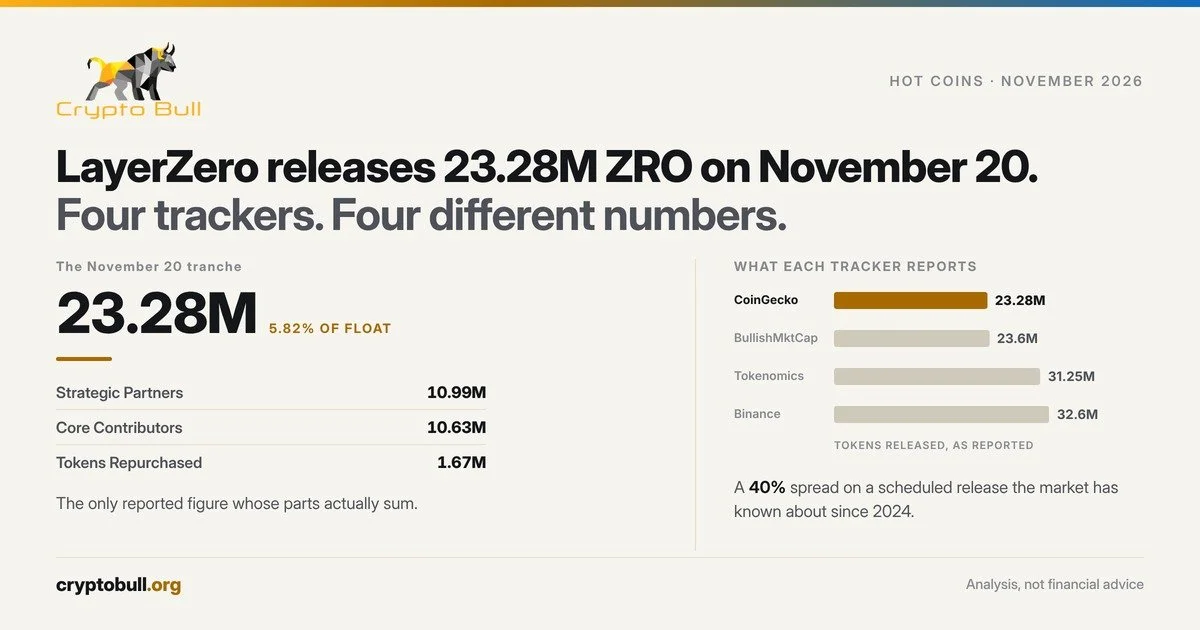
LayerZero ZRO token unlock schedule chart showing 23.28 million tokens releasing November 20, 2026
Unlock Detail Table:
| Recipient | ZRO Released | Share of Tranche |
|---|---|---|
| Strategic Partners | 10.99M | 47.2% |
| Core Contributors | 10.63M | 45.6% |
| Tokens Repurchased | 1.67M | 7.2% |
| Total | 23.28M | 5.82% of float |
The finding is the divergence, not the unlock.
Over the seven days into this release, BTC fell 13.1% and ETH fell 13.2%. ZRO moved the other way. An asset holding or gaining ground in the week before a 5.82% supply release, while the two majors shed an eighth of their value, is doing something the unlock narrative does not explain.
The honest reading is that this is a small-cap moving on its own news flow rather than a market verdict on the unlock. LayerZero shipped ATLAS-powered perpetuals integration this week and absorbed the Stargate merger earlier in the year. At a $571 million market cap, a single integration announcement moves the price more than a scheduled release the market has priced for two years.
Why the tape matters more than the token. The sentiment reading is where the real story sits. CoinGecko's global Fear and Greed widget printed 22 — Extreme Fear on November 17. The weekly brief recorded 10 on November 16, sourced to Alternative.me via two aggregators. Those two readings are three days and twelve points apart, and they are not the same measurement.
This is a trap CryptoBull has already documented. Four outlets published 26, 28, 28 and 29 for the same day on November 12. Different providers weight volatility, volume, social data and dominance differently and publish under the same name. A reader who sees "Fear and Greed is at 10" and acts on it is acting on one vendor's model, not on a market fact. Our guide on how market sentiment indicators are actually constructed walks through why the providers disagree and which inputs drive the spread.
So the frame is this: a routine supply release is landing in a market where the sentiment instruments themselves cannot agree on how frightened people are, where US spot BTC and ETH ETFs took $1.4642 billion of net outflows over November 9 to 13, and where stablecoin supply has fallen $16.0 billion over thirty days. Thin liquidity is what turns a priced-in unlock into a price move.
What would falsify this. Three things, and they are checkable.
If ZRO's seven-day outperformance reverses before November 20, the divergence was noise and this post's central observation was wrong. If the released tranche prints materially above 23.28 million — if Tokenomics' 31.25 million turns out to be the real number — then the supply pressure is a third larger than described here and the framing understates the risk. And if the December fee-switch referendum passes, the buyback-and-burn mechanism changes the supply arithmetic enough that monthly unlock analysis stops being the right lens entirely.
What this is not. It is not a call that the unlock will push the price down. Scheduled releases are the most thoroughly pre-priced events in this asset class, and the base rate for retail traders attempting to position around them is poor. It is a note that the supply calendar and the sentiment calendar have collided, and that the collision is worth watching rather than trading.
ZRO joins the Hot Coins tracker as pick number 61. Across the 55 picks where the all-time high was reachable after the call date, the average ATH return from the call is approximately +1,545%, with the best at roughly +26,200%.
See the full nine-year record, every pick, every price, live: CryptoBull Hot Coins Tracker.
Related: our write-up on the Plasma XPL unlock and insider supply risk applies the same supply-calendar lens to a different asset.