
Monad's Unlock Isn't 132% Of Supply. Here's The Real Math.
Monad's one-year anniversary unlock lands on November 24, and the published figures for it disagree by a factor of 1.6 — 6.66 billion MON by one source, 10.7 billion by another. Several aggregators have gone further and described it as exceeding 100% of circulating supply, with one specific claim of 132.2%. That number is arithmetically impossible, and tracing where it comes from explains more about this token than the unlock itself does.
What could go wrong
The supply picture first, because it is the whole story. Monad reports a circulating supply of 11.82 billion MON against a total supply of about 100.68 billion and a maximum of 114.16 billion. But 51.37 billion is already "unlocked" by schedule — a gap of about 39.55 billion tokens that exist and are unlocked but are not in circulation. The unlocked figure is more than four times the float that actually trades. That gap is the single most important structural fact about this asset, and it is why coverage of the same event produces wildly different headlines.
Supply has four legitimate measures, and mixing them is how the bad numbers get made. Circulating is 11.82B. Unlocked by schedule is 51.37B. Total issued today is 100.68B. Maximum after all emissions is 114.16B. Those are not four competing answers — they measure four different things, and the project's own figures reconcile with all of them. The "uncapped" reading carried by one aggregator is simply wrong.
The anniversary unlock is real, dated and unquantified. November 24 is confirmed, and the recipients are confirmed as investors, the Category Labs treasury and the team. The size is not settled. We are not going to pick one of the two published numbers and present it as fact.
No audit was found. We checked every source used for this piece and found no audit of Monad's contracts, no named auditor and no audit date. That is a conspicuous gap for a chain that, as of today, carries Visa settlement traffic. It may well exist and simply not be surfaced by the sources we read.
Unlocked tokens are not sold tokens. Vesting eligibility is not a sale. The relevant question is whether the ~39.55 billion unlocked-but-not-circulating tokens move, and that is observable on-chain rather than predictable from a schedule.
Regulatory. Nothing in the current docket names Monad, the Monad Foundation or Category Labs. For market context: FinCEN issued an order on November 6 targeting MEXC, restricting US financial institutions from processing certain transfers involving that platform. The SEC's proposed crypto broker-dealer rules are reported sent to the White House for review — proposed, not adopted.
Macro. US October CPI was scheduled for November 10 and PPI for November 13, into a tape that has been falling. BTC and ETH figures below carry verification flags.
Monad ($MON) Denominator Table:
| Reported tranche | ÷ circulating 11.82B | ÷ unlocked 51.37B | ÷ total 100.68B | ÷ max 114.16B | USD at $0.01656 |
|---|---|---|---|---|---|
| 10.7B — Monad Foundation | 90.5% | 20.8% | 10.6% | 9.4% | ~$177.2M |
| 6.66B — Tokenomist | 56.3% | 13.0% | 6.6% | 5.8% | ~$110.3M |
Where 132% comes from
Both published figures are internally consistent with their own denominators. The Foundation's "~10.7% of initial token supply" matches 10.7 billion against a 100 billion initial supply. Tokenomist's "6.6% of total supply" matches 6.66 billion against 100.68 billion. Neither source made a percentage error.
The error is downstream. Third parties took a tranche denominated against total supply and divided it by circulating supply. Against 11.82 billion circulating, 10.7 billion reads as 90.5%. To reach 132.2% you need a circulating supply of about 8.09 billion — a figure no current source supports, and one that looks like a stale float reading from earlier in the token's life.
Four denominators are each defensible for different questions. Against max supply you are asking about dilution once every scheduled emission has landed. Against total supply you are asking about dilution against what exists today. Against the unlocked float you are asking what share of already-unlocked tokens this represents. Against circulating supply you are asking about near-term pressure on the tradeable float — the most alarming framing, and the one most frequently misapplied. Use one, say which, and the number stops moving.
What we still cannot tell you
The tranche size. 10.7 billion against 6.66 billion is a 1.6× gap on the totals and a 14.3× gap on the team component — 10.7 billion against Tokenomist's 749.7 million team line.
The likeliest explanation, and we are labelling this a hypothesis rather than a finding: the Foundation's 10.7% probably describes the cumulative team allocation that becomes vested and eligible by the anniversary, while Tokenomist's figure is the single-day release. Team tokens are reported to vest over three to four years from each individual's joining date rather than on a single cliff, which would produce exactly this kind of divergence between "eligible by" and "released on."
We could not confirm it. Monad's own tokenomics pages failed to load across repeated attempts, and Tokenomist's event-level schedule is behind a paywall. Until one of those opens, the honest answer is that the size of this unlock is not publicly settled — and that is a more useful thing to know than a confident number would have been.
The Monad Data Table:
| Metric | MON | Source |
|---|---|---|
| Public mainnet launch | 2025-11-24 | Monad documentation |
| Price, Nov 11 2026 | $0.01656 | CoinMarketCap 09:22:12 UTC; CoinGecko family within 0.9% |
| Market cap | ~$195.8M | CoinMarketCap $195.83M |
| All-time high | $0.04883 (2025-11-26) | CoinStats, Altcoin Buzz, CoinMarketCap |
| Drawdown from ATH | −66.1% | Calculated |
| All-time low | $0.01533 (2026-11-08) | Altcoin Buzz, CoinMarketCap |
| ATH return from call date | n/a — ATH predates call | Peak set ~1yr before this call |
| Circulating supply | 11,825,165,000 | Five sources, exact agreement |
| Unlocked by schedule | 51.37B — 45% of max, 4.3x the float | CoinMarketCap, reported by the project |
| Total supply | ~100.68B | CoinGecko, CoinMarketCap, CoinStats |
| Max supply | 114.16B — 100B initial + 14.16B emissions | CoinMarketCap, reported by the project |
The Benchmark Table for $MON:
| Asset | Price | All-time high | Down from ATH |
|---|---|---|---|
| MON | $0.01656 | $0.04883 (2025-11-26) | −66.1% |
| BTC | $73,754 | $126,080 (2025-10-06) | −41.5% |
| ETH | $2,052.74 | $4,946.05 (2025-08-24) | −58.5% |
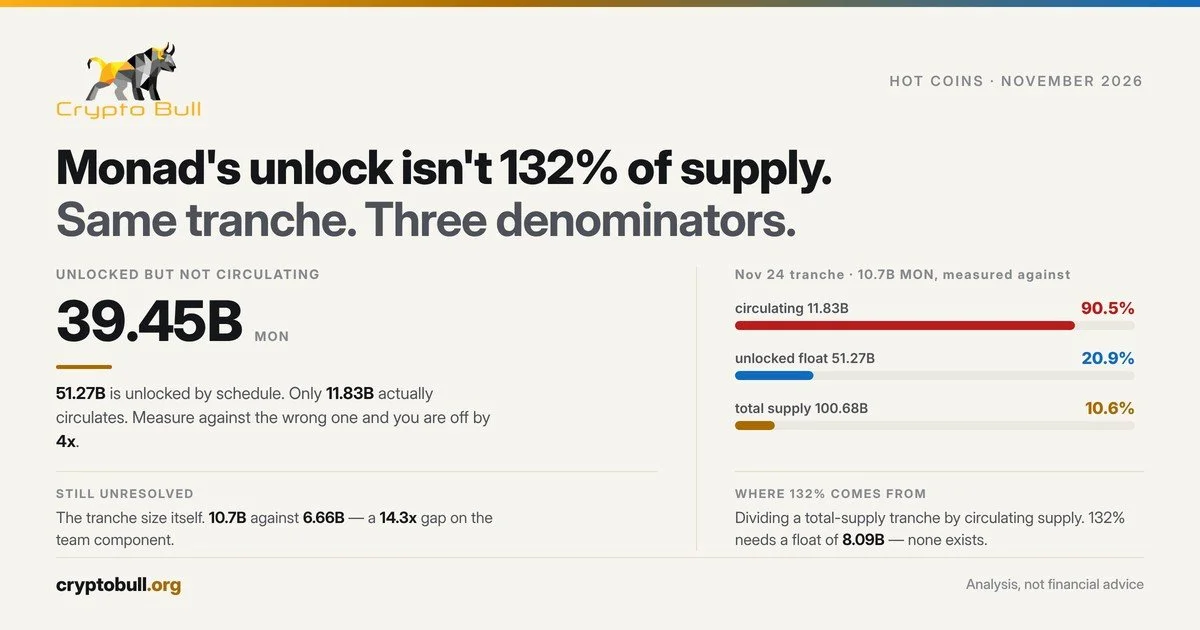
Monad MON November 2026 anniversary unlock denominator analysis, circulating versus unlocked versus total supply
The catalyst, stated accurately
On November 10, 2026, Visa added Monad as a settlement option in its stablecoin settlement programme. Visa issuers and acquirers can use it now — this is live, not announced-for-later. A privacy feature called Private Settlement, which would let institutions keep transaction details confidential while sharing them with auditors or regulators on request, is expected in the coming months.
Three things to keep in proportion:
Monad is one of ten. It joins Avalanche, Ethereum, Solana, Stellar, Circle's Arc, Base, Canton, Polygon and Tempo. Visa's own framing is "multi-chain settlement infrastructure," and Dan Roesbery, Visa's VP of global onchain partnerships, described the goal as giving partners "the flexibility to settle on the blockchain networks that best meet their needs." This is inclusion in a list, not selection from a field.
No Monad-specific volume figure exists. Visa reported an annualised stablecoin settlement run rate of about $20 billion as of September 2026, up more than 15× year over year, across 225-plus stablecoin-linked card programmes. None of that is attributed to Monad, and none of it will be for some time.
The announcement was sourced to the Monad Foundation, not to Visa's newsroom.
Alongside it: the reUSD stablecoin is live on Monad, Pump.fun has integrated, and Ankr has launched x402 payments starting with Monad. One data aggregator attributed MON's modest intraday gain to the reUSD launch rather than to Visa.
The thesis, and what would falsify it
Monad is a parallel-execution EVM L1 whose pitch is throughput without abandoning Ethereum tooling. The team is the strongest credential in the package — Jump Trading engineers with a Paradigm-led $225M round behind them — and inclusion in Visa's settlement programme is the first evidence of institutional distribution rather than crypto-native distribution. The token, meanwhile, trades 66.1% off its high, three days off an all-time low, with a large unquantified unlock approaching. That asymmetry is the entire reason this is interesting.
What would falsify it:
The November 24 tranche lands at the high end and the unlocked-but-uncirculating 39.55 billion begins moving to exchanges. The float is the number to watch, not the schedule.
Visa settlement volume on Monad stays at zero. Being one of ten options means nothing until flow arrives, and flow is measurable.
Private Settlement slips past "the coming months." It is the only part of the Visa relationship that is Monad-specific rather than generic.
An audit still cannot be located. For a settlement chain that becomes a disqualifying question rather than a gap.
Emissions run ahead of schedule. Only about 0.68B of the 14.16B emission budget has been issued so far; the pace of the rest is not something we could source.
What would confirm it: attributable Visa settlement volume on Monad, Private Settlement shipping on schedule, and the post-unlock float staying near 11.8 billion rather than stepping toward 51 billion.
The record
MON joins 59 prior picks in the CryptoBull Hot Coins record going back to 2017. Every call, its date, its price at the call and its all-time high are published on the Hot Coins Tracker — including the losses, and including the rows where an asset's all-time high predates our call and the ATH return is shown as n/a rather than as a percentage. MON is one of those rows from day one: it peaked two days after its own mainnet launch, a year before we called it.
Related reading: Cronos CRO burn vote and Strategic Reserve vesting — another monthly supply-release schedule, analysed the same way.
Disclosure. This is analysis, not financial advice.