
Crypto's Best Quarter Since 2024, Then October Took It Back
Crypto's third quarter was its best since late 2024: total market capitalization rose 39.6% to $2.96 trillion, an $840.1 billion gain that ended three straight quarters of decline. Three weeks into October, roughly $270 billion of that is gone.
The split is the story. September was driven by falling-rate expectations and ETF inflows. On September 16 the Federal Reserve raised rates for the first time since 2023, and the market spent October repricing for a central bank that is tightening rather than easing. Everything below follows from that one change.
What is the regulatory status of US crypto as of October 2026?
Two federal processes are live and one is dead. Taking them in order of how much they actually change.
The SEC's Regulation Crypto Assets comment period closes today, October 20, 2026. Proposed August 18 and published in the Federal Register on August 21, it would create two exemptions from Securities Act registration for investment contracts involving crypto assets, pair them with a principles-based disclosure regime, offer a conditional safe harbor from the definition of "investment contract," and preempt state securities registration for offerings made under those exemptions. State preemption is the provision with the most practical consequence and the least coverage.
The CLARITY Act is finished for this Congress. The House passed H.R. 3633 on July 17, 2025 by 294–134. On September 15, 2026 the Senate failed to invoke cloture on the motion to proceed, 49–50, against the 60 votes needed. The sticking points were ethics provisions covering federal officials' crypto holdings and the treatment of yield-bearing stablecoins, on concerns they would pull deposits out of banks. Senator Tillis voted no specifically to preserve a motion to reconsider, so a revival path technically exists — but the November 3 midterms compress the remaining calendar to the point where passage this Congress is not a reasonable base case.
The CFTC has started, and started slowly. On September 17 it sent "Regulation Crypto Asset Transactions and Regulation Crypto Asset Markets" (RIN 3038-AF80) to OIRA for review. It sits at the prerule stage, meaning the text is not public, a proposed rule and comment period still have to happen, and binding rules are plausibly more than a year out.
What this adds up to. Market structure legislation is not arriving in 2026. The rulemaking that will actually govern US crypto markets is being written by two agencies on multi-quarter timelines, and the SEC is roughly a year ahead of the CFTC. Anyone pricing in a legislative catalyst this year is pricing in something that already failed on the Senate floor.
How did crypto perform in fall 2026?
Bitcoin is up 3.6% since September 1 and down 2.6% in October. Ethereum is down 3.5% since September 1 and down 11.3% in October. The whole fall gain is September's, and the October reversal has been materially harder on ETH than on BTC.
Table 1: Crypto Fall Scorecard 2026
| Metric | Sep 1, 2026 | Sep 30, 2026 | Oct 20, 2026 | Fall to date |
|---|---|---|---|---|
| Bitcoin | $78,562.74 | $83,556.14 | $81,382 | +3.6% |
| Ethereum | $2,467.13 | $2,684 | $2,382 | -3.5% |
| Total market cap | — | $2.96T | $2.69T | -9.1% in Oct |
| BTC dominance | — | — | 60.32% | Risk-off |
Bitcoin's September range was wide: a low of $74,887.50 on September 15 and a high of $87,397.00 on September 21. It sits 6.9% below that high today and 8.7% above that low. Against the Q3 close, bitcoin has given back a quarter of what it gained in September while ethereum has given back more than all of it.
Dominance at 60.32% is the cleanest single read on the quarter's turn. Capital is consolidating into bitcoin, which is what happens when the macro regime tightens and the marginal buyer gets more selective — not what happens in the alt-season conditions that Q3's 39.6% gain briefly suggested were forming.
What drove the October crypto selloff?
Four things, in order of how much each explains.
1. The Fed is hiking, not cutting. On September 16 the FOMC raised the federal funds target range to 3.75%–4.00%, the first increase since 2023. Markets now place roughly an 80% probability on a hold at the October 27–28 meeting, with the live decision pushed to December 9, where a move to 4.00%–4.25% is firmly expected. Crypto has not traded in a tightening regime since 2022, and October was the repricing.
2. ETF flows reversed. September saw net inflows of $2.65 billion into US spot bitcoin ETFs across 21 trading days, led by BlackRock's IBIT at $1,807.8 million. October flipped: by October 9, bitcoin ETFs had shed $407.4 million and ether ETFs $578.9 million, a combined $986.3 million. Ether ETFs ran eight consecutive sessions of outflows beginning September 29, totalling about $641.3 million.
3. Energy prices. Brent crude pushed above $101 on tensions around the Strait of Hormuz, lifting yields and the dollar together. That combination has been reliably negative for crypto, and it arrived in the same window as a September CPI print of 3.7% against a 3.6% expectation.
4. Leverage. Perpetual futures open interest rose 40.6% across Q3 and crossed $100 billion in September. That positioning was the fuel for roughly $487 million of long liquidations on October 7 and about $771 million across October 12 and 13. The liquidations did not cause the move; they amplified it.
What is not on this list. The CLARITY Act's Senate failure on September 15 produced little visible price impact. Neither did the Bitget hot wallet breach on September 24, with unauthorized transfers estimated at about $351.6 million, which cost the exchange its top-ten spot volume ranking but not the market its bid. It is worth naming the events that did not matter, because a lot of coverage this month has implied they did.
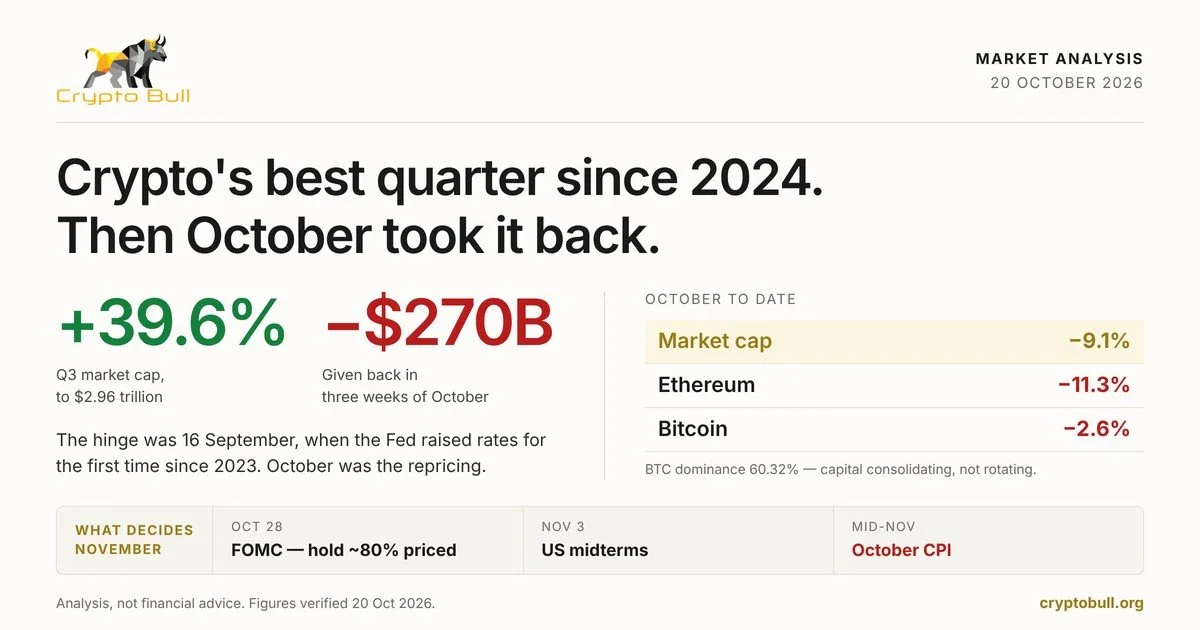
Fall 2026 crypto market recap chart showing Q3 gains of 39.6 percent followed by an October decline, with Bitcoin at $81,382 and Ethereum at $2,382 on October 20, 2026
Table 2: ETF Flows Fall 2026 Crypto
| US spot ETF flows | September 2026 | October 2026 (to Oct 9) |
|---|---|---|
| Bitcoin | +$2.65B | -$407.4M |
| Ether | Net positive | -$578.9M |
| Largest single fund | IBIT +$1,807.8M | — |
What are the crypto catalysts for November 2026?
Three dated events and one release that matters more than the other three combined.
Table 3: November Calendar Crypto 2026
| Date | Event | Why it matters |
|---|---|---|
| Oct 28 | FOMC decision | Hold is ~80% priced. The signal is the dissents and the language, not the rate. |
| Nov 3 | US midterm elections | Shapes the 2027 legislative calendar. Changes nothing in 2026. |
| Mid-Nov | October CPI release | The single most important input into the December 9 decision. |
| Dec 9 | FOMC decision and projections | Hike to 4.00%–4.25% is the base case. Updated dot plot. |
What is the crypto outlook for November 2026?
November is a macro month, not a crypto month. There is no protocol upgrade, ETF decision or legislative vote on the November calendar large enough to override the rate path. That makes the forecast unusually tractable, and it makes most of the November commentary you will read beside the point.
Our read, stated plainly so it can be checked against later.
Base case — choppy, range-bound, downside skew into mid-November. The December hike is being priced in, and crypto has spent three weeks learning to trade a tightening Fed. We expect that repricing to continue in smaller increments rather than resolve. Bitcoin dominance stays elevated and alts keep underperforming, because a tightening regime narrows the marginal buyer's risk appetite before it changes their direction.
The variable that decides it is the mid-November CPI print. If October CPI comes in at or below roughly 3.4%, December hike odds compress, and the repricing that drove October reverses fast — that is the bull case, and it does not require anything crypto-specific to happen. If it prints at or above 3.7% again, December becomes a near-certainty and the October trend extends into year-end.
The midterms are the most overrated item on the calendar. The legislative outcome people are trading was already decided on the Senate floor on September 15. An election on November 3 changes which bills are possible in 2027. It does not revive the CLARITY Act in 2026, and it does not touch the SEC and CFTC rulemakings, which proceed on agency timelines regardless of who controls either chamber.
What would falsify this. Three things, each observable:
Bitcoin reclaims and holds $87,397 — September's high. That would mean the market is through the repricing rather than in it, and the rate path has stopped being the dominant variable.
ETF flows turn net positive for two consecutive weeks before the CPI print. October's outflows are the cleanest proxy for institutional conviction. If they reverse ahead of the data, the marginal buyer is not waiting for the Fed.
Dominance falls below roughly 57% while the total market cap is flat or rising. That would signal genuine risk appetite returning rather than the defensive consolidation visible today.
If none of the three happens by the December 9 meeting, the tightening thesis holds and there is nothing new to say about November.
What did CryptoBull call this fall?
Four Hot Coins picks ran between mid-September and mid-October, and the thread connecting them was supply rather than price. That was deliberate. In a tightening regime, token unlock schedules do more to set an individual asset's path than sentiment does, and schedules are knowable in advance in a way sentiment is not.
Plasma (XPL): the unlock and insider supply risk — called September 22. The thesis was that insider supply overhang, not demand, would set the price. XPL is down 17.9% since, against bitcoin's 6.0% over the same window.
Cronos (CRO): burn vote, strategic reserve and vesting — called September 29, built around a governance vote on burning supply.
io.net (IO): unlock dilution against locked supply — called October 6.
Aptos (APT): insider vesting ended and unlocks fell 60% — called October 14, and the mirror image of the others: a schedule that got better instead of worse.
Every call we have made since 2017 is on the Hot Coins Tracker — 58 picks, with call price, all-time high and live price, sortable, including the ones that went wrong. Where a pick's all-time high was set before we called it, the tracker shows "n/a" rather than a percentage, because that peak was not reachable by anyone acting on the call.
For the sentiment and news data behind the macro read above, the News and Sentiment Tracker updates continuously. If you want the framework rather than the calls, the portfolio strategy guide covers position sizing into exactly this kind of regime change.
This is independent analysis and not financial advice.