
Aptos Insider Vesting Ended. APT Unlocks Just Fell 60%.
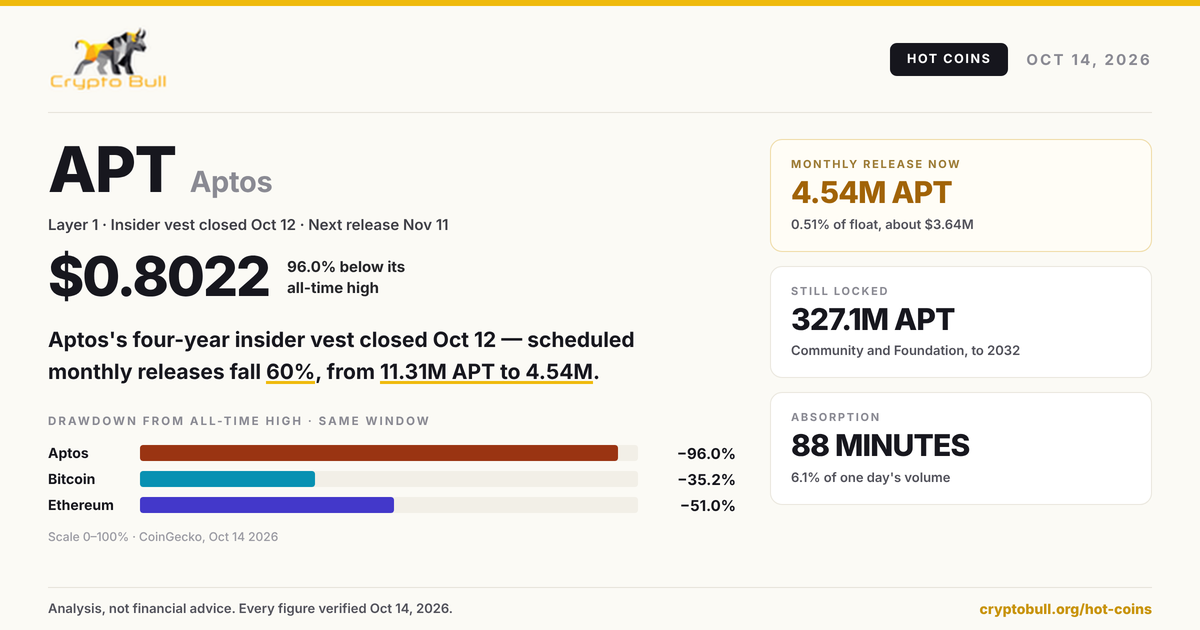
Aptos's four-year vesting cycle for core contributors and early backers closed on October 12, 2026, the fourth anniversary of mainnet. Scheduled monthly releases fall from 11.31 million APT to 4.54 million, a 60% cut, and the token fell 13.8% in the twenty-four hours around it.
That gap is the story. The supply schedule got structurally better and the market did not care.
What could go wrong
The permanent lock is an intention, not an executed transaction. The Aptos Foundation states it "will ensure that 210 million APT will be locked and permanently staked for the network." That is 64% of the 327.1 million APT still locked. If it happens, the forward schedule is transformed. If it does not, nothing in this post's supply math changes except the part that matters most. Nothing verified this session shows the lock executed on-chain.
The 2.1 billion cap is a governance proposal. The Foundation's own language is that it "will propose via governance a hard protocol-level cap of 2.1 billion APT." A proposal is not a protocol rule. Treat the cap as directional until the vote and the implementation are both confirmed.
A widely published figure for this unlock is wrong, and it is still circulating. Trackers this week describe the monthly release as 0.64% of supply. Against the 882,869,000 APT verified circulating this session, 11.31 million APT is 1.28% of circulating and 0.54% of the 2.1 billion cap. There is no supply base in the verified data that produces 0.64%. This exact denominator defect is why this asset was rejected as a pick on October 6; it has not been corrected upstream.
The forward schedule does not reconcile as published. Secondary reporting says the remaining Community and Foundation balance releases "1/120 of the remaining balance" monthly until 2032. That mechanism does not produce 4.54 million per month: 331.69 million divided by 120 is 2.76 million, and a declining-balance schedule would fall further every month. A fixed-amount reading does reconcile, exactly — 4.54 million multiplied by 120 months is 544.8 million; subtract the 331.69 million still locked and 213.11 million was released across the 47 months since October 2022, which is 4.534 million per month. The 327.1 million verified locked today, divided by 4.54 million, is 72.06 months, landing in October 2032 — matching the published end date to the month. The arithmetic says fixed, the source says declining, and the difference is the entire shape of the forward curve.
Regulatory, sector-wide. The SEC's Regulation Crypto Assets comment period closes October 20, 2026. Six newly dated items landed in the week to October 9: three CFTC actions on leveraged retail crypto, event contracts and the swap definition; an ESMA opinion on noncompliant stablecoins under MiCA with a three-month remediation window; an EU Council position backing direct ESMA supervision of major cross-border CASPs; and the New York Attorney General's settlement with Celsius co-founder Alex Mashinsky carrying a permanent industry bar. None of these name Aptos. All of them price into a token with a $689 million market cap.
| Measure | Before Oct 12 | After Oct 12 |
|---|---|---|
| Scheduled monthly release | 11,310,000 APT | 4,540,000 APT |
| Share of circulating supply | 1.28% | 0.51% |
| Share of 2.1B cap | 0.54% | 0.22% |
| Dollar value at $0.7802 | $8.82M | $3.54M |
| Hours of average volume to absorb | 2.15 hours | 0.86 hours |
| Annualized release | 135.72M APT | 54.48M APT |
| Recipients | 6.77M insiders + 4.54M Community/Foundation | Community and Foundation pools only |
Two numbers in that table are worth separating from the rest.
The recipient change is the whole mechanism. Core contributors held 190 million APT at genesis and early backers 134.78 million — 324.78 million combined, 32.48% of the 1 billion minted at launch, released across 48 months. That is 6.77 million per month, and 6.77 million plus 4.54 million is 11.31 million: the insider tranche was 60% of every monthly release, and it has stopped. Tokenomist's published allocation table gives core contributors 19.00% and investors 13.48%, which sums to 32.48% — the genesis figures reconcile from an independent source.
The post-vest release is now small against liquidity, not just against supply. $3.54 million of new supply per month against $98.4 million of daily volume is under an hour of average turnover. A monthly unlock that clears in 52 minutes is not a dilution event; it is noise. The pre-vest release was 2.15 hours, which was also absorbable — the change is from small to negligible, and anyone framing this as relief from a supply crisis is overselling it.
| Asset | Price | 24h | Below ATH | Market cap |
|---|---|---|---|---|
| APT | $0.7802 | -13.80% | -96.1% | $688.8M |
| BTC | $83,095.20 | -0.30% | -34.1% | $1.67T |
| ETH | $2,493.43 | -1.90% | -49.5% | $304.7B |
All five columns pulled from CoinGecko in a single session, October 13, 2026.
The thesis
The benchmark table is the argument. APT fell 13.80% on a day BTC fell 0.30% and ETH fell 1.90%, and it sits 96.1% below its all-time high against BTC's 34.1% and ETH's 49.5%. This is not a token being repriced by its supply schedule. It is a token being repriced by something else entirely, on a day its supply schedule improved by 60%.
Which makes this a specific and testable claim rather than a directional one: if insider supply was a material driver of APT's drawdown, the 60% cut should show up in relative performance against BTC and ETH over the next two to three monthly release cycles — November 11, December 11 and January 11. The releases are dated and the benchmark is public. There is no interpretation required.
The reason to care is that this window does not expire. Unlike a countdown to a dated unlock, a regime change can be written about on day one and measured for months. The reason to be skeptical is in the same sentence: a structural improvement that produced a 13.8% single-day decline is evidence that the market was not pricing insider supply as the binding constraint in the first place.
What would falsify it
APT continues to underperform BTC and ETH through the January 11 release. Three cycles of a 60% smaller schedule with no relative improvement means supply was never the driver, and the thesis is dead on its own terms.
The 210 million permanent lock does not execute. The strongest forward element is an unexecuted intention. If the Foundation does not complete it, the remaining distributable float stays at 327.1 million rather than 117.1 million, and the 2032 runway stands rather than compressing to roughly late 2028.
The release mechanism turns out to be a declining 1/120 balance rather than a fixed amount. Then monthly supply is 2.76 million and falling, the headline 4.54 million figure in every outlet this week is wrong, and this post's reconciliation is the error instead.
The 2.1 billion cap fails at governance. An uncapped supply schedule removes the ceiling the entire structural case rests on.
The record
CryptoBull has published 57 Hot Coins picks since 2017, each with its original call date, call price and all-time high tracked publicly on the Hot Coins Tracker. The anchor results, measured as all-time-high return from the call date: LINK +4,796%, NANO +4,603%, HNT +3,990%.
APT does not get an all-time-high return figure in this post, and the reason is worth stating plainly. APT's all-time high was reached before this call date, so an "ATH return from call" calculation on it would report a peak that was never available to anyone acting on this call. It would be a real number describing nothing. The tracker will display one for the APT row until a flag for pre-call highs ships; read that cell as an artifact, not a result.
Prior unlock-driven picks in this series: io.net's locked supply overhang and the Cronos burn vote against Strategic Reserve vesting.
Analysis only, not financial advice. Every price, supply and market-cap figure above was pulled from CoinGecko on October 13, 2026 and is stated as of that session.